Linkages: Types and Motion Conversion
Introduction
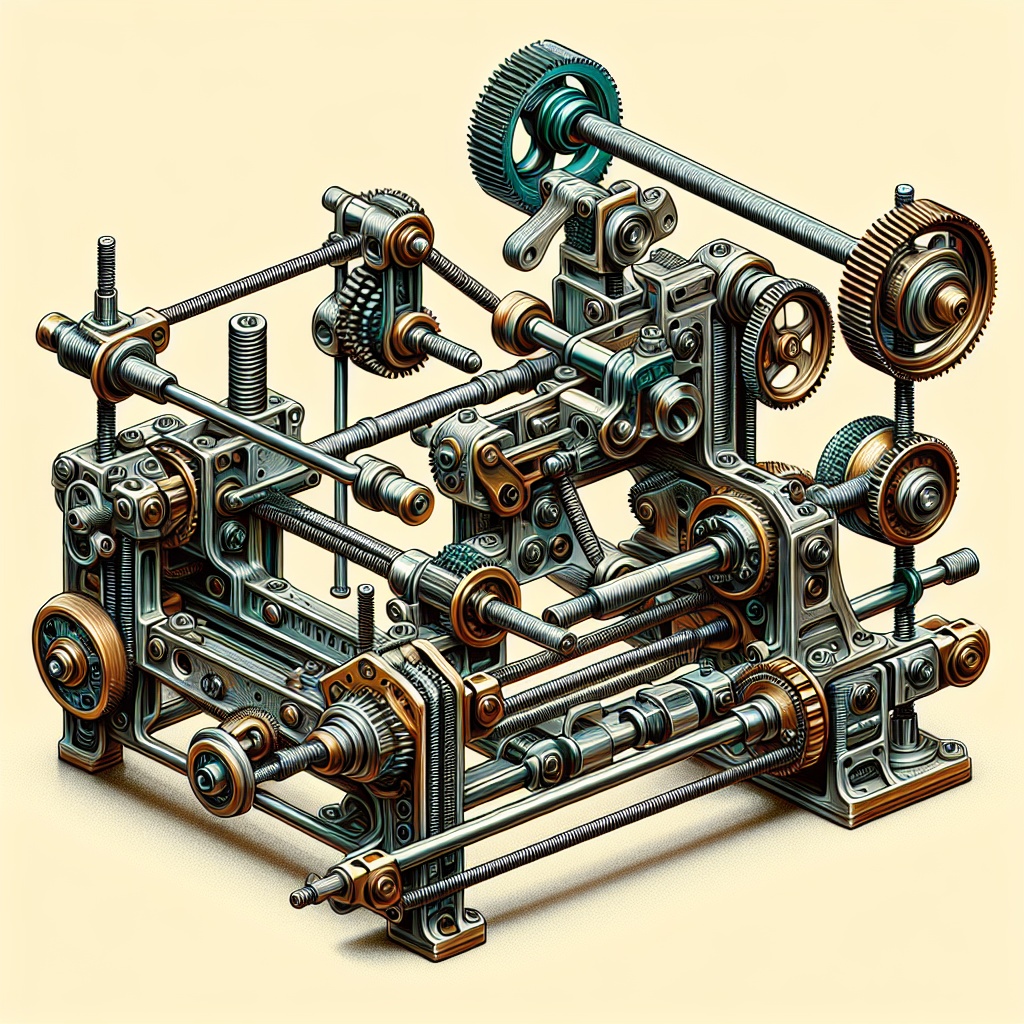
In the field of Mechanics of Machines in Engineering, linkages play a crucial role in the design and functionality of various mechanical systems. Linkages are assemblies of rigid bodies connected by joints to form a closed chain or a series of closed chains. These systems are fundamental in converting one type of motion into another, making them indispensable in numerous engineering applications. From simple mechanisms like levers and pulleys to complex machinery in automotive and aerospace industries, understanding the types and motion conversion capabilities of linkages is essential for engineers. This article delves into the various aspects of linkages, including their types, motion conversion principles, historical development, applications, advanced topics, and challenges.
Fundamentals
Basic Principles and Concepts
Linkages are mechanical systems composed of links (rigid bodies) connected by joints (kinematic pairs) to produce a desired motion. The primary purpose of a linkage is to transfer motion and force from one part of a machine to another. The key terms and concepts related to linkages include:
- Link: A rigid body that forms part of a linkage.
- Joint: A connection between two or more links that allows relative motion.
- Kinematic Pair: A pair of links connected by a joint.
- Degrees of Freedom (DOF): The number of independent movements allowed by a joint.
- Grashof’s Law: A criterion used to determine the mobility of a four-bar linkage.
Types of Linkages
Linkages can be classified based on their structure and the type of motion they produce:
- Four-Bar Linkage: Consists of four links and four joints, commonly used in mechanisms like crank-rocker and double-rocker systems.
- Slider-Crank Linkage: Converts rotational motion into linear motion, widely used in internal combustion engines.
- Double-Slider Linkage: Contains two sliding pairs and is used in mechanisms like the Scotch yoke.
- Parallelogram Linkage: Maintains parallelism between links, used in applications like pantographs and robotic arms.
Motion Conversion
Linkages are designed to convert one type of motion into another. The primary types of motion conversion include:
- Rotational to Linear: Achieved using slider-crank mechanisms, where a rotating crank drives a sliding link.
- Linear to Rotational: Inverse of the above, where a sliding link drives a rotating crank.
- Rotational to Oscillatory: Achieved using crank-rocker mechanisms, where a rotating crank drives an oscillating rocker.
- Oscillatory to Rotational: Inverse of the above, where an oscillating rocker drives a rotating crank.
Historical Development
The study and application of linkages have a rich historical background, with significant contributions from various cultures and notable figures:
- Ancient Civilizations: Early examples of linkages can be traced back to ancient civilizations like the Greeks and Romans, who used mechanisms like the Antikythera mechanism and Roman water wheels.
- Leonardo da Vinci: The Renaissance polymath made significant contributions to the study of linkages, designing various mechanisms for converting motion.
- James Watt: The Scottish engineer improved the steam engine by developing the parallel motion linkage, which converted linear motion to rotational motion.
- Franz Reuleaux: The German engineer and kinematician made substantial contributions to the theory of machines and mechanisms, including the classification of linkages.
Applications
Linkages find applications in a wide range of industries and fields, demonstrating their versatility and importance:
Automotive Industry
Linkages are integral to the functioning of various automotive components:
- Engine Mechanisms: Slider-crank linkages are used in internal combustion engines to convert the reciprocating motion of pistons into rotational motion of the crankshaft.
- Suspension Systems: Parallelogram linkages are used in suspension systems to maintain wheel alignment and improve ride quality.
- Steering Mechanisms: Four-bar linkages are used in steering systems to convert the rotational motion of the steering wheel into the angular motion of the wheels.
Aerospace Industry
Linkages play a crucial role in the aerospace industry, particularly in the design of control systems:
- Flight Control Surfaces: Linkages are used to transmit pilot inputs to control surfaces like ailerons, elevators, and rudders.
- Landing Gear Mechanisms: Complex linkages are used to retract and extend landing gear, ensuring smooth operation and stability.
Robotics
In robotics, linkages are essential for creating precise and controlled movements:
- Robotic Arms: Parallelogram linkages are used to maintain the orientation of end effectors, enabling tasks like welding, painting, and assembly.
- Walking Robots: Four-bar and six-bar linkages are used to mimic the gait of animals, providing stability and mobility.
Medical Devices
Linkages are also used in various medical devices to enhance functionality and precision:
- Surgical Robots: Linkages enable precise control of surgical instruments, allowing for minimally invasive procedures.
- Prosthetic Limbs: Linkages are used to replicate the natural motion of human limbs, improving the quality of life for amputees.
Advanced Topics
Recent Research and Innovations
Recent advancements in the field of linkages have led to innovative solutions and improved performance:
- Compliant Mechanisms: These mechanisms use flexible elements instead of rigid links, allowing for smoother motion and reduced wear.
- Microelectromechanical Systems (MEMS): Linkages at the microscale are used in MEMS devices for applications like sensors, actuators, and micro-robots.
- Reconfigurable Mechanisms: These mechanisms can change their configuration to perform multiple tasks, enhancing versatility and efficiency.
Future Trends
The future of linkages in engineering is likely to be shaped by several emerging trends:
- Integration with Smart Materials: The use of smart materials like shape memory alloys and piezoelectric materials can enhance the functionality and adaptability of linkages.
- Advanced Simulation and Optimization: Improved computational tools and algorithms will enable more efficient design and optimization of linkage mechanisms.
- Biomimetic Designs: Inspired by natural systems, biomimetic linkages will lead to more efficient and adaptable mechanisms.
Challenges and Considerations
Despite their numerous advantages, linkages also present certain challenges and considerations:
- Complexity: Designing and analyzing complex linkage systems can be challenging, requiring advanced mathematical and computational tools.
- Wear and Tear: Mechanical linkages are subject to wear and tear, necessitating regular maintenance and replacement of components.
- Precision: Achieving high precision in linkage mechanisms can be difficult, especially in applications requiring fine control.
- Material Limitations: The performance of linkages is often limited by the properties of the materials used, such as strength, stiffness, and fatigue resistance.
Potential solutions to these challenges include the development of new materials, improved manufacturing techniques, and advanced design methodologies. Further research in these areas will help overcome existing limitations and enhance the performance of linkage mechanisms.
Conclusion
Linkages are fundamental components in the field of Mechanics of Machines in Engineering, playing a vital role in converting motion and transmitting forces. Understanding the types of linkages and their motion conversion capabilities is essential for designing efficient and functional mechanical systems. From their historical development to their wide-ranging applications in industries like automotive, aerospace, robotics, and medical devices, linkages have proven to be indispensable. Recent advancements and future trends promise to further enhance the capabilities and versatility of linkage mechanisms. However, challenges such as complexity, wear and tear, and material limitations must be addressed through ongoing research and innovation. Overall, the study of linkages remains a critical area in engineering, driving the development of advanced mechanical systems and technologies.