Kinematic Analysis of Mechanisms: Principles and Methods
Introduction
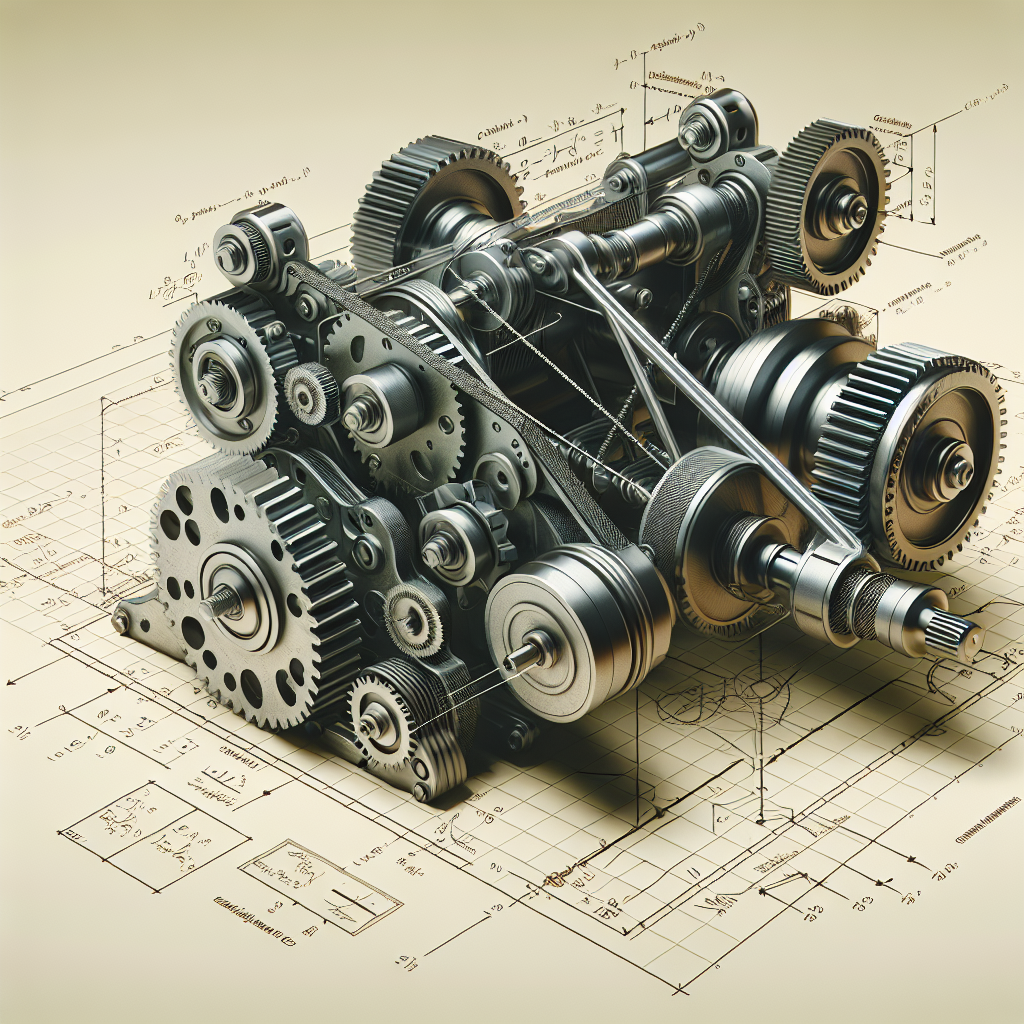
The kinematic analysis of mechanisms is a fundamental aspect of the Mechanics of Machines in Engineering. It involves the study of motion without considering the forces that cause it. This analysis is crucial for designing and understanding the behavior of various mechanical systems, from simple linkages to complex robotic arms. By examining the relative motion of components within a mechanism, engineers can predict the system’s performance, optimize its design, and ensure its reliability. The importance of kinematic analysis extends across multiple industries, including automotive, aerospace, robotics, and manufacturing, making it a cornerstone of modern engineering practice.
Fundamentals
Basic Principles and Concepts
Kinematics is the branch of mechanics that deals with the motion of objects without considering the forces that cause the motion. The primary goal of kinematic analysis is to determine the positions, velocities, and accelerations of the various parts of a mechanism. Key concepts in kinematic analysis include:
- Linkages: These are rigid bodies connected by joints to form a closed chain or a series of closed chains.
- Degrees of Freedom (DOF): This refers to the number of independent movements a mechanism can perform. It is determined by the number of links and joints in the system.
- Joints: These are connections between two or more links that allow relative motion. Common types of joints include revolute (rotational) and prismatic (translational) joints.
- Position Analysis: This involves determining the location of each link in a mechanism at a given instant.
- Velocity Analysis: This involves determining the speed and direction of each link in a mechanism.
- Acceleration Analysis: This involves determining the rate of change of velocity of each link in a mechanism.
Theories and Key Terms
Several theories and key terms are essential for understanding kinematic analysis:
- Grashof’s Law: This law helps determine the mobility of four-bar linkages. It states that for a four-bar linkage, if the sum of the shortest and longest link lengths is less than or equal to the sum of the other two link lengths, the linkage will have at least one link that can make a full rotation.
- Instantaneous Center of Rotation (ICR): This is the point around which a link rotates at a given instant. It is crucial for velocity analysis.
- Relative Motion: This concept involves analyzing the motion of one link relative to another, which is essential for understanding the overall motion of the mechanism.
Historical Development
The study of kinematics has a rich history, with contributions from many notable figures:
- Leonardo da Vinci (1452-1519): One of the earliest contributors to the study of mechanisms, da Vinci’s sketches and designs laid the groundwork for future developments in kinematics.
- Galileo Galilei (1564-1642): Galileo’s work on the motion of pendulums and falling bodies contributed to the understanding of kinematic principles.
- James Watt (1736-1819): Watt’s invention of the parallel motion linkage for steam engines was a significant milestone in the practical application of kinematic analysis.
- Franz Reuleaux (1829-1905): Known as the father of kinematics, Reuleaux developed systematic methods for analyzing mechanisms and introduced the concept of kinematic pairs and chains.
These historical milestones have paved the way for modern kinematic analysis, which now incorporates advanced mathematical techniques and computer-aided design (CAD) tools.
Applications
Kinematic analysis has a wide range of practical applications across various industries:
Automotive Industry
In the automotive industry, kinematic analysis is used to design and optimize suspension systems, steering mechanisms, and transmission systems. For example, the analysis of a car’s suspension system ensures that the wheels maintain proper contact with the road surface, providing a smooth ride and improving vehicle handling.
Aerospace Industry
In aerospace engineering, kinematic analysis is crucial for designing control surfaces, landing gear mechanisms, and robotic arms used in space exploration. The precise movement of these components is essential for the safety and efficiency of aircraft and spacecraft.
Robotics
Robotic systems rely heavily on kinematic analysis to control the movement of robotic arms and manipulators. By understanding the kinematics of these systems, engineers can program robots to perform complex tasks with high precision, such as assembly, welding, and material handling.
Manufacturing
In manufacturing, kinematic analysis is used to design and optimize machinery and automation systems. For instance, the analysis of conveyor systems, robotic assembly lines, and CNC machines ensures efficient and accurate production processes.
Case Study: Robotic Arm
A case study of a robotic arm used in an automotive assembly line illustrates the practical application of kinematic analysis. By analyzing the kinematics of the robotic arm, engineers can determine the optimal path for the arm to follow, ensuring that it can reach all necessary points without collisions or excessive wear on the joints. This analysis helps improve the efficiency and reliability of the assembly process.
Advanced Topics
Advanced Kinematic Theories
Recent advancements in kinematic analysis have introduced new theories and techniques:
- Screw Theory: This theory provides a comprehensive framework for analyzing the motion of rigid bodies in three-dimensional space. It is particularly useful for understanding the kinematics of complex mechanisms, such as robotic arms and parallel manipulators.
- Computational Kinematics: The use of computer algorithms and numerical methods has revolutionized kinematic analysis. Techniques such as the Denavit-Hartenberg (D-H) parameters and the Jacobian matrix are now commonly used to model and analyze the kinematics of robotic systems.
Recent Research and Innovations
Recent research in kinematic analysis has focused on several key areas:
- Soft Robotics: The development of soft robotic systems, which use flexible materials and structures, has introduced new challenges and opportunities for kinematic analysis. Researchers are exploring novel methods to model and control the motion of these systems.
- Human-Robot Interaction: Advances in kinematic analysis are enabling more intuitive and safe interactions between humans and robots. This includes the development of exoskeletons and assistive devices that enhance human capabilities.
- Bio-inspired Mechanisms: Inspired by the movement of living organisms, researchers are developing new mechanisms that mimic the kinematics of biological systems. These bio-inspired designs have applications in robotics, medical devices, and more.
Challenges and Considerations
Despite its many applications, kinematic analysis presents several challenges and considerations:
Complexity
The complexity of modern mechanisms, especially in robotics and aerospace, can make kinematic analysis challenging. Advanced mathematical techniques and computational tools are often required to model and analyze these systems accurately.
Accuracy
Ensuring the accuracy of kinematic models is crucial for reliable performance. Small errors in the model can lead to significant deviations in the actual motion of the mechanism. Engineers must carefully validate their models and consider factors such as manufacturing tolerances and material properties.
Real-time Analysis
In applications such as robotics and automation, real-time kinematic analysis is essential for controlling the motion of mechanisms. This requires efficient algorithms and powerful computing resources to perform the analysis quickly and accurately.
Potential Solutions
To address these challenges, researchers are exploring several potential solutions:
- Machine Learning: The use of machine learning algorithms can help improve the accuracy and efficiency of kinematic analysis. These algorithms can learn from data and adapt to changes in the system, providing more robust models.
- Advanced Sensors: The integration of advanced sensors, such as accelerometers and gyroscopes, can provide real-time feedback on the motion of mechanisms. This data can be used to refine kinematic models and improve control strategies.
- Collaborative Research: Collaboration between researchers, engineers, and industry professionals can help address the challenges of kinematic analysis. By sharing knowledge and resources, the field can continue to advance and innovate.
Conclusion
The kinematic analysis of mechanisms is a vital aspect of the Mechanics of Machines in Engineering. It provides the foundation for understanding and designing a wide range of mechanical systems, from simple linkages to complex robotic arms. By examining the motion of components within a mechanism, engineers can optimize designs, improve performance, and ensure reliability. The historical development of kinematic analysis has been marked by significant contributions from notable figures, and recent advancements continue to push the boundaries of what is possible. Despite the challenges and complexities involved, ongoing research and innovation promise to further enhance the field, making kinematic analysis an indispensable tool in modern engineering practice.