Applications of Mechanics of Machines in Product Design
Introduction
The field of Mechanics of Machines is a cornerstone of engineering, playing a pivotal role in the design, analysis, and optimization of mechanical systems. This discipline focuses on understanding the behavior of machines and mechanisms, which are integral to a wide range of industries, from automotive to aerospace, manufacturing to robotics. The application of Mechanics of Machines in product design is particularly significant as it ensures that products are not only functional but also efficient, reliable, and safe. This article delves into the various aspects of Mechanics of Machines in product design, highlighting its importance, fundamental principles, historical development, practical applications, advanced topics, challenges, and future trends.
Fundamentals
Mechanics of Machines involves the study of forces and motion in mechanical systems. Key concepts include kinematics, which deals with the motion of bodies without considering the forces that cause the motion, and kinetics, which involves the forces and torques that cause motion. Understanding these principles is essential for designing mechanisms that perform desired tasks efficiently.
Key Terms and Definitions
- Kinematics: The study of motion without considering the forces that cause it.
- Kinetics: The study of forces and torques and their effect on motion.
- Mechanism: A system of moving parts that performs a specific function.
- Degrees of Freedom: The number of independent movements a mechanism can perform.
- Linkage: A series of connected links that transfer motion and force.
- Cam: A rotating or sliding piece in a mechanical linkage used to transform rotary motion into linear motion.
- Gear: A rotating machine part with cut teeth that mesh with another toothed part to transmit torque.
Historical Development
The study of Mechanics of Machines dates back to ancient civilizations, where early engineers and inventors created simple machines like levers, pulleys, and gears. The Renaissance period saw significant advancements with figures like Leonardo da Vinci, who designed numerous mechanical devices. The Industrial Revolution marked a pivotal era with the development of complex machinery and the formalization of mechanical engineering as a discipline.
Key Milestones
- Archimedes (287-212 BC): Developed the principles of levers and pulleys.
- Leonardo da Vinci (1452-1519): Designed numerous mechanical devices and studied the motion of bodies.
- James Watt (1736-1819): Improved the steam engine, leading to the Industrial Revolution.
- Franz Reuleaux (1829-1905): Known as the father of kinematics, he developed the theory of machines and mechanisms.
Applications
The principles of Mechanics of Machines are applied across various industries to design and optimize products. These applications ensure that products are efficient, reliable, and meet specific performance criteria.
Automotive Industry
In the automotive industry, Mechanics of Machines is crucial for designing engines, transmissions, and suspension systems. For example, the design of a car’s suspension system involves understanding the kinematics and kinetics of linkages to ensure a smooth ride and optimal handling.
Aerospace Industry
In aerospace, the design of aircraft components such as landing gear, control surfaces, and propulsion systems relies heavily on the principles of Mechanics of Machines. The precise movement and control of these components are critical for the safety and performance of aircraft.
Manufacturing Industry
Mechanics of Machines is essential in the design of manufacturing equipment such as robotic arms, conveyor systems, and CNC machines. These machines must perform repetitive tasks with high precision and reliability, which requires a deep understanding of kinematics and kinetics.
Case Study: Robotic Arm Design
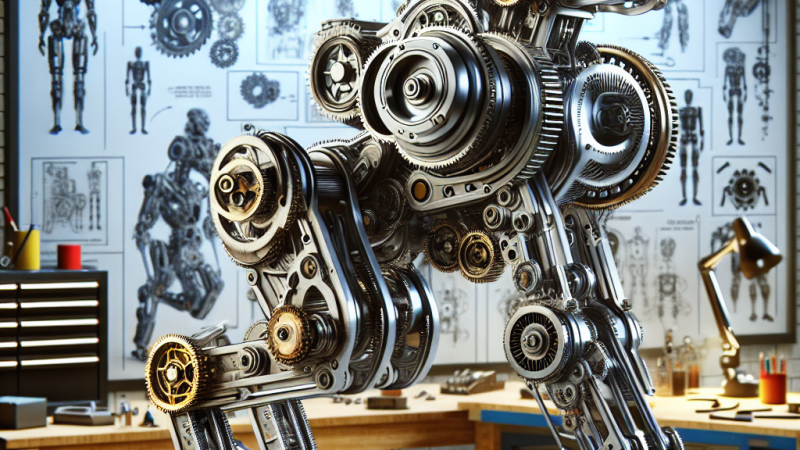
A robotic arm used in manufacturing is a prime example of applying Mechanics of Machines in product design. The arm’s movement is controlled by a series of linkages and joints, each with specific degrees of freedom. By analyzing the kinematics and kinetics of the arm, engineers can optimize its design for speed, accuracy, and load-carrying capacity.
Advanced Topics
As technology advances, so do the techniques and theories in Mechanics of Machines. Recent research and innovations have led to new methods and tools for designing and analyzing mechanical systems.
Computer-Aided Design (CAD) and Simulation
Modern product design heavily relies on CAD software and simulation tools. These tools allow engineers to create detailed models of mechanisms and simulate their behavior under various conditions. This approach reduces the need for physical prototypes and accelerates the design process.
Mechatronics
Mechatronics is an interdisciplinary field that combines mechanics, electronics, and computer science. It plays a significant role in the design of advanced mechanical systems such as autonomous robots and smart manufacturing equipment. Understanding the integration of mechanical and electronic components is crucial for developing these systems.
Recent Innovations
- 3D Printing: Allows for the rapid prototyping and production of complex mechanical components.
- Artificial Intelligence (AI): Used to optimize the design and control of mechanical systems.
- Internet of Things (IoT): Enables real-time monitoring and control of mechanical systems through connected devices.
Challenges and Considerations
While the application of Mechanics of Machines in product design offers numerous benefits, it also presents several challenges and considerations.
Complexity
The design of mechanical systems can be highly complex, requiring a deep understanding of various principles and the ability to integrate multiple components seamlessly. This complexity can lead to longer development times and higher costs.
Material Selection
The choice of materials is critical in mechanical design. Materials must be selected based on their mechanical properties, such as strength, durability, and weight. Advances in material science continue to provide new options, but selecting the right material remains a challenge.
Environmental Impact
Designing sustainable and environmentally friendly products is increasingly important. Engineers must consider the environmental impact of their designs, including energy consumption, emissions, and recyclability.
Potential Solutions
- Advanced Simulation Tools: Help reduce complexity by providing detailed insights into system behavior.
- Material Research: Ongoing research into new materials can provide better options for mechanical design.
- Sustainable Design Practices: Incorporating sustainability into the design process can mitigate environmental impact.
Conclusion
The application of Mechanics of Machines in product design is a vital aspect of engineering that ensures the development of efficient, reliable, and safe mechanical systems. From the historical advancements that laid the foundation to the modern innovations driving the field forward, the principles of Mechanics of Machines continue to play a crucial role in various industries. While challenges remain, ongoing research and technological advancements promise to address these issues and pave the way for even more sophisticated and sustainable mechanical designs. As we look to the future, the importance of Mechanics of Machines in engineering will only continue to grow, driving innovation and improving the quality of products across the globe.