Vehicle Dynamics
Introduction

Vehicle dynamics is a critical field within automotive engineering that focuses on the behavior of vehicles in motion. It encompasses the study of forces and moments acting on a vehicle, the vehicle’s response to these forces, and the resulting motion. Understanding vehicle dynamics is essential for designing safer, more efficient, and higher-performing vehicles. This field is highly relevant in engineering as it directly impacts vehicle stability, handling, ride comfort, and overall performance. With the advent of advanced driver-assistance systems (ADAS) and autonomous vehicles, the importance of vehicle dynamics has only increased, making it a cornerstone of modern automotive engineering.
Fundamentals
Basic Principles and Concepts
Vehicle dynamics involves several fundamental principles and concepts that are crucial for understanding how vehicles behave under various conditions. These include:
- Newton’s Laws of Motion: These laws form the foundation of vehicle dynamics, describing the relationship between a vehicle’s motion and the forces acting upon it.
- Force and Moment: Forces such as gravity, friction, and aerodynamic drag, along with moments (torques), influence a vehicle’s motion. Understanding these forces and moments is essential for analyzing vehicle behavior.
- Center of Gravity (CG): The CG is the point where the vehicle’s mass is considered to be concentrated. Its location affects vehicle stability and handling.
- Inertia: Inertia refers to a vehicle’s resistance to changes in its state of motion. It plays a significant role in vehicle dynamics, particularly during acceleration, braking, and cornering.
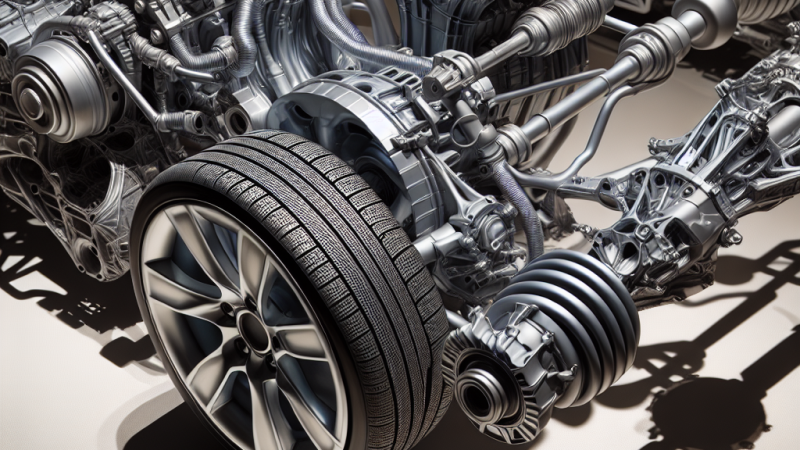
- Suspension Systems: The suspension system connects the vehicle’s body to its wheels and plays a crucial role in ride comfort, handling, and stability.
- Tire Dynamics: Tires are the only contact points between the vehicle and the road. Understanding tire behavior, including grip, slip, and deformation, is vital for vehicle dynamics.
Key Terms
- Understeer: A condition where the front wheels lose grip before the rear wheels, causing the vehicle to turn less than intended.
- Oversteer: A condition where the rear wheels lose grip before the front wheels, causing the vehicle to turn more than intended.
- Yaw: The rotational motion of a vehicle around its vertical axis.
- Pitch: The rotational motion of a vehicle around its lateral axis.
- Roll: The rotational motion of a vehicle around its longitudinal axis.
Historical Development
The study of vehicle dynamics has evolved significantly over the years, driven by advancements in technology and a deeper understanding of physics. Some key milestones in the historical development of vehicle dynamics include:
- Early 20th Century: The advent of the automobile industry saw the initial exploration of vehicle dynamics. Engineers began to study the effects of weight distribution, suspension systems, and tire behavior on vehicle performance.
- 1950s-1960s: The development of more sophisticated suspension systems, such as independent suspension, improved vehicle handling and ride comfort. Notable figures like Maurice Olley and Colin Chapman made significant contributions to the field during this period.
- 1970s-1980s: The introduction of computer-aided design (CAD) and simulation tools revolutionized vehicle dynamics analysis. Engineers could now model and simulate vehicle behavior under various conditions, leading to more precise designs.
- 1990s-Present: The rise of electronic stability control (ESC) systems and advanced driver-assistance systems (ADAS) has further advanced the field. Modern vehicles are equipped with sensors and control systems that enhance stability, handling, and safety.
Applications
Vehicle dynamics has a wide range of practical applications across various industries and fields. Some notable applications include:
Automotive Industry
In the automotive industry, vehicle dynamics is crucial for designing and developing vehicles that offer superior performance, safety, and comfort. Examples include:
- Sports Cars: High-performance sports cars rely on advanced vehicle dynamics to achieve exceptional handling, stability, and acceleration.
- Commercial Vehicles: Trucks and buses require robust vehicle dynamics to ensure stability and safety, especially when carrying heavy loads.
- Electric Vehicles (EVs): EVs benefit from optimized vehicle dynamics to maximize efficiency and range while maintaining performance.
Motorsports
Vehicle dynamics plays a pivotal role in motorsports, where precision and performance are paramount. Engineers use advanced simulations and real-time data analysis to fine-tune race cars for optimal performance on the track.
Autonomous Vehicles
The development of autonomous vehicles relies heavily on vehicle dynamics to ensure safe and reliable operation. Autonomous systems must accurately predict and control vehicle behavior in various driving scenarios.
Aerospace Industry
While primarily focused on aircraft, the aerospace industry also benefits from vehicle dynamics principles. For example, the design of landing gear systems and ground handling of aircraft involves similar dynamics concepts.
Advanced Topics
Recent Research and Innovations
Recent research in vehicle dynamics has led to several innovations and advanced concepts, including:
- Active Suspension Systems: These systems use sensors and actuators to continuously adjust suspension settings, providing optimal ride comfort and handling.
- Vehicle-to-Everything (V2X) Communication: V2X technology enables vehicles to communicate with each other and with infrastructure, enhancing safety and traffic management.
- Machine Learning and AI: Machine learning algorithms are being used to predict and optimize vehicle behavior, improving performance and safety.
- Advanced Tire Modeling: Researchers are developing more accurate tire models to better understand tire-road interactions and improve vehicle dynamics simulations.
Future Trends
The future of vehicle dynamics is likely to be shaped by several emerging trends, including:
- Electrification: As electric vehicles become more prevalent, vehicle dynamics will need to adapt to the unique characteristics of electric powertrains.
- Autonomous Driving: The continued development of autonomous vehicles will require advanced vehicle dynamics to ensure safe and reliable operation.
- Connected Vehicles: The integration of connected vehicle technologies will enable more sophisticated vehicle dynamics control and optimization.
Challenges and Considerations
Despite the advancements in vehicle dynamics, several challenges and considerations remain:
- Complexity: Vehicle dynamics is inherently complex, involving numerous variables and interactions. Accurately modeling and simulating these dynamics can be challenging.
- Cost: Developing and implementing advanced vehicle dynamics systems can be expensive, particularly for smaller manufacturers.
- Regulatory Compliance: Ensuring that vehicle dynamics systems comply with safety and regulatory standards is essential but can be challenging.
- Environmental Factors: External factors such as weather conditions and road surfaces can significantly impact vehicle dynamics, requiring robust systems to account for these variables.
Potential solutions to these challenges include continued research and development, collaboration between industry and academia, and the use of advanced simulation and testing tools.
Conclusion
Vehicle dynamics is a vital field within automotive engineering that directly impacts the safety, performance, and comfort of vehicles. By understanding the fundamental principles, historical development, practical applications, advanced topics, and challenges associated with vehicle dynamics, engineers can design and develop vehicles that meet the demands of modern transportation. As technology continues to evolve, the importance of vehicle dynamics will only grow, making it an essential area of focus for the future of automotive engineering.