Mechanisms in Machines: Concepts and Applications
Introduction
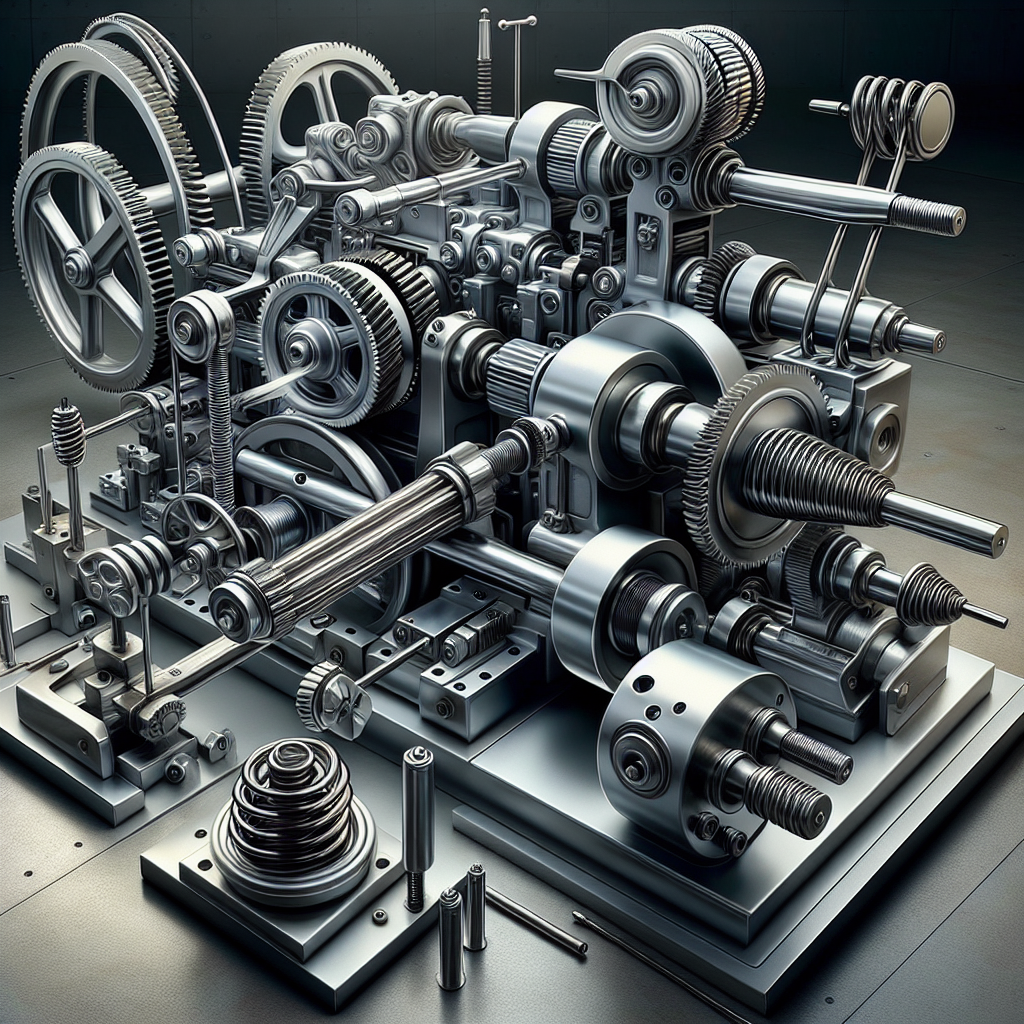
Mechanisms in machines are fundamental components in the field of engineering, particularly within the discipline known as the Mechanics of Machines. These mechanisms are the building blocks that enable machines to perform a wide range of functions, from simple tasks like opening a door to complex operations such as robotic surgery. Understanding the principles and applications of mechanisms is crucial for engineers who design, analyze, and maintain machinery. This article delves into the concepts, historical development, applications, advanced topics, and challenges associated with mechanisms in machines, providing a comprehensive overview of their importance and relevance in engineering.
Fundamentals
Basic Principles and Concepts
At its core, a mechanism is a system of moving parts that transmits motion and forces to perform a specific task. The study of mechanisms involves understanding how these parts interact, how motion is generated and controlled, and how forces are transmitted. Key terms and concepts in this field include:
- Linkages: These are assemblies of links (rigid bodies) connected by joints to form a closed chain or series of closed chains. Linkages are used to convert motion and forces in a controlled manner.
- Joints: The connections between links that allow relative motion. Common types of joints include revolute (rotational) joints, prismatic (sliding) joints, and spherical joints.
- Degrees of Freedom (DOF): The number of independent movements a mechanism can perform. For example, a simple hinge has one degree of freedom (rotation).
- Kinematics: The study of motion without considering forces. Kinematic analysis involves determining the positions, velocities, and accelerations of the components of a mechanism.
- Dynamics: The study of forces and torques and their effect on motion. Dynamic analysis considers the forces that cause motion and the resulting accelerations.
Theories and Key Terms
Several theories and principles underpin the study of mechanisms in machines:
- Grashof’s Law: A criterion used to determine the mobility of four-bar linkages. It states that for a four-bar linkage, the sum of the shortest and longest link lengths must be less than or equal to the sum of the other two link lengths for the mechanism to be movable.
- Inversion: The process of obtaining different mechanisms by fixing different links in a kinematic chain. Each inversion results in a different type of motion and application.
- Instantaneous Center of Rotation (ICR): A point in a moving body or system of bodies at which the velocity is zero at a particular instant. It is used in kinematic analysis to simplify the study of motion.
Historical Development
Early Innovations
The study and application of mechanisms date back to ancient civilizations. The Greeks and Romans developed early mechanisms such as the Antikythera mechanism, an ancient Greek analog computer used to predict astronomical positions and eclipses. The Roman engineer Vitruvius described various machines and mechanisms in his work “De Architectura.”
Renaissance and Industrial Revolution
The Renaissance period saw significant advancements in the study of mechanisms, with notable contributions from Leonardo da Vinci, who designed numerous mechanical devices and studied the principles of motion and force transmission. The Industrial Revolution further accelerated the development of mechanisms, with the invention of steam engines, textile machinery, and other industrial equipment. James Watt’s improvements to the steam engine and the development of the flyball governor are key milestones from this era.
Modern Developments
In the 20th century, the study of mechanisms became more formalized with the development of kinematic and dynamic theories. The advent of computers and advanced simulation tools has revolutionized the design and analysis of mechanisms, allowing for more complex and efficient machines. Notable figures in modern mechanism theory include Franz Reuleaux, who is considered the father of kinematics, and Ferdinand Freudenstein, who made significant contributions to the field of mechanism synthesis.
Applications
Automotive Industry
Mechanisms play a crucial role in the automotive industry, where they are used in engines, transmissions, suspension systems, and steering mechanisms. For example, the internal combustion engine relies on a complex mechanism of pistons, crankshafts, and camshafts to convert fuel into motion. Similarly, the transmission system uses gear mechanisms to transfer power from the engine to the wheels.
Robotics
In robotics, mechanisms are used to create articulated arms, grippers, and locomotion systems. These mechanisms enable robots to perform tasks such as assembly, welding, and material handling. A notable example is the robotic arm used in manufacturing, which employs a series of linkages and joints to achieve precise movements.
Aerospace Industry
The aerospace industry relies on mechanisms for various applications, including control surfaces, landing gear, and propulsion systems. For instance, the landing gear mechanism of an aircraft involves a complex system of linkages and actuators that allow for the retraction and extension of the gear during takeoff and landing.
Medical Devices
Mechanisms are also integral to medical devices such as surgical robots, prosthetics, and diagnostic equipment. Surgical robots use precise mechanisms to perform minimally invasive procedures, while prosthetic limbs employ linkages and joints to mimic natural human movement.
Advanced Topics
Compliant Mechanisms
Compliant mechanisms are a class of mechanisms that achieve motion through the flexibility of their components rather than through traditional joints. These mechanisms offer advantages such as reduced weight, fewer parts, and increased reliability. Recent research in this area focuses on the design and optimization of compliant mechanisms for applications in aerospace, robotics, and biomedical devices.
Microelectromechanical Systems (MEMS)
MEMS are miniature devices that integrate mechanical and electrical components at the microscale. These systems use microfabrication techniques to create tiny mechanisms that can perform sensing, actuation, and control functions. MEMS technology is used in various applications, including accelerometers, pressure sensors, and microfluidic devices.
Parallel Mechanisms
Parallel mechanisms consist of multiple kinematic chains that connect a base to a moving platform. These mechanisms offer high stiffness, precision, and load-carrying capacity. They are used in applications such as flight simulators, machine tools, and robotic manipulators. Recent advancements in parallel mechanism design focus on improving their workspace, dexterity, and control algorithms.
Challenges and Considerations
Design Complexity
The design of mechanisms can be complex, requiring a deep understanding of kinematics, dynamics, and material properties. Engineers must consider factors such as load capacity, wear and tear, and manufacturing constraints. Advanced simulation tools and optimization algorithms can help address these challenges, but they also require specialized knowledge and expertise.
Precision and Accuracy
Achieving high precision and accuracy in mechanisms is critical for applications such as robotics and aerospace. Factors such as backlash, friction, and thermal expansion can affect the performance of mechanisms. Engineers must carefully design and test mechanisms to ensure they meet the required specifications.
Material Selection
The choice of materials for mechanisms is crucial for their performance and durability. Materials must be selected based on their mechanical properties, such as strength, stiffness, and fatigue resistance. Advances in materials science, including the development of composites and smart materials, offer new opportunities for improving the performance of mechanisms.
Cost and Manufacturing
The cost and complexity of manufacturing mechanisms can be significant, particularly for high-precision or custom-designed components. Engineers must balance performance requirements with cost considerations, often requiring trade-offs between different design options. Additive manufacturing (3D printing) is emerging as a promising technology for producing complex mechanisms with reduced cost and lead time.
Conclusion
Mechanisms in machines are fundamental to the field of Mechanics of Machines in Engineering. They enable the design and operation of a wide range of devices and systems, from simple tools to advanced robotic systems. Understanding the principles, historical development, applications, advanced topics, and challenges associated with mechanisms is crucial for engineers and researchers. As technology continues to advance, new opportunities and challenges will arise, driving further innovation and development in this essential field. The study of mechanisms remains a dynamic and vital area of engineering, with significant implications for various industries and applications.