Aircraft Structures
Introduction
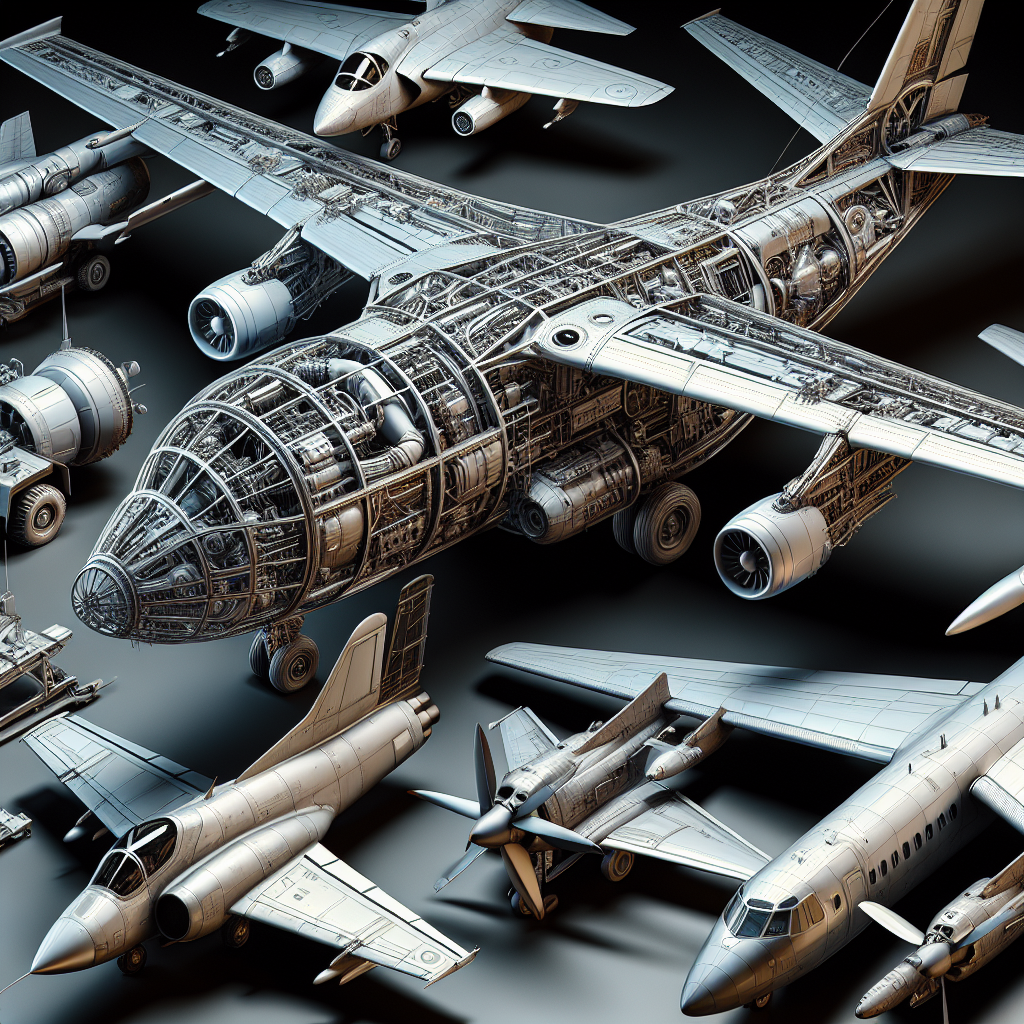
Aircraft structures are a fundamental aspect of aerospace engineering, encompassing the design, analysis, and manufacturing of the physical components that make up an aircraft. These structures must be meticulously engineered to ensure safety, performance, and efficiency. The importance of aircraft structures cannot be overstated, as they play a critical role in the overall functionality and reliability of an aircraft. This article delves into the various facets of aircraft structures, exploring their fundamentals, historical development, applications, advanced topics, and the challenges faced in this field.
Fundamentals
Basic Principles and Concepts
Aircraft structures are designed to withstand various loads and stresses encountered during flight, including aerodynamic forces, gravitational forces, and operational loads. The primary goal is to create a structure that is both lightweight and strong, optimizing performance while ensuring safety.
Key Terms
- Load: The forces acting on an aircraft structure, including lift, weight, thrust, and drag.
- Stress: The internal resistance of a material to deformation, typically measured in Pascals (Pa).
- Strain: The deformation or displacement of a material in response to stress.
- Fatigue: The weakening of a material caused by repeated cyclic loading.
- Composite Materials: Engineered materials made from two or more constituent materials with different physical or chemical properties.
Theories
Several theories underpin the design and analysis of aircraft structures:
- Elasticity Theory: Describes how materials deform under various loads and return to their original shape when the load is removed.
- Plasticity Theory: Explains the behavior of materials that undergo permanent deformation when subjected to loads beyond their elastic limit.
- Fracture Mechanics: Studies the propagation of cracks in materials and predicts the conditions under which they will grow.
- Finite Element Analysis (FEA): A computational method used to predict how structures respond to external forces, vibrations, and other physical effects.
Historical Development
Early Innovations
The development of aircraft structures has a rich history, beginning with the Wright brothers’ first powered flight in 1903. Their aircraft, the Wright Flyer, featured a wooden frame covered with fabric, a design that set the stage for future innovations.
World War I and II
During World War I and II, the demand for more robust and efficient aircraft led to significant advancements in materials and design. The use of metal, particularly aluminum, became prevalent due to its lightweight and high-strength properties. Notable figures such as Hugo Junkers and Geoffrey de Havilland made significant contributions during this period.
Post-War Era
The post-war era saw the introduction of jet engines, which required more advanced structural designs to handle higher speeds and greater stresses. The development of composite materials, such as fiberglass and carbon fiber, revolutionized aircraft structures by offering superior strength-to-weight ratios.
Applications
Aerospace Industry
In the aerospace industry, aircraft structures are critical for both commercial and military aviation. Modern commercial aircraft, such as the Boeing 787 Dreamliner and the Airbus A350, extensively use composite materials to reduce weight and improve fuel efficiency. Military aircraft, like the F-22 Raptor and the B-2 Spirit, rely on advanced structural designs to achieve stealth and superior performance.
Space Exploration
Aircraft structures also play a vital role in space exploration. Spacecraft, such as the Space Shuttle and the International Space Station (ISS), require structures that can withstand the harsh conditions of space, including extreme temperatures and radiation. The use of lightweight, high-strength materials is crucial for the success of these missions.
Automotive and Other Industries
The principles and technologies developed for aircraft structures have found applications in other industries, such as automotive and civil engineering. For example, the use of carbon fiber in high-performance sports cars improves their strength and reduces weight, enhancing speed and fuel efficiency.
Advanced Topics
Recent Research and Innovations
Recent research in aircraft structures focuses on improving materials and manufacturing processes. Additive manufacturing, or 3D printing, is revolutionizing the production of complex structural components, allowing for greater design flexibility and reduced production times. Additionally, advancements in nanomaterials and smart materials are opening new possibilities for enhancing the performance and durability of aircraft structures.
Future Trends
The future of aircraft structures lies in the continued development of advanced materials and technologies. Researchers are exploring the use of graphene, a material with exceptional strength and conductivity, for potential applications in aircraft structures. Furthermore, the integration of artificial intelligence (AI) and machine learning in the design and analysis processes promises to optimize structural performance and reduce development costs.
Challenges and Considerations
Structural Integrity and Safety
Ensuring the structural integrity and safety of aircraft is a significant challenge. Engineers must account for various factors, such as material fatigue, environmental conditions, and manufacturing defects, to prevent structural failures. Rigorous testing and maintenance protocols are essential to address these challenges.
Cost and Manufacturing
The cost of developing and manufacturing advanced aircraft structures can be prohibitive. The use of high-performance materials and sophisticated manufacturing techniques often results in higher production costs. Balancing performance, safety, and cost is a critical consideration for engineers and manufacturers.
Environmental Impact
The environmental impact of aircraft structures is another important consideration. The production and disposal of composite materials can have significant environmental consequences. Researchers are exploring sustainable materials and recycling methods to mitigate these impacts.
Conclusion
Aircraft structures are a cornerstone of aerospace engineering, encompassing the design, analysis, and manufacturing of the physical components that make up an aircraft. From the early innovations of the Wright brothers to the advanced materials and technologies of today, the development of aircraft structures has been marked by significant milestones and contributions from notable figures. The practical applications of aircraft structures extend beyond aviation, influencing industries such as automotive and space exploration. As research and innovation continue to advance, the future of aircraft structures promises to bring new materials, technologies, and solutions to address the challenges faced in this field. Ultimately, the importance of aircraft structures in ensuring the safety, performance, and efficiency of aircraft underscores their critical role in the field of aerospace engineering.