Transient Conduction: Concepts and Solutions
Introduction
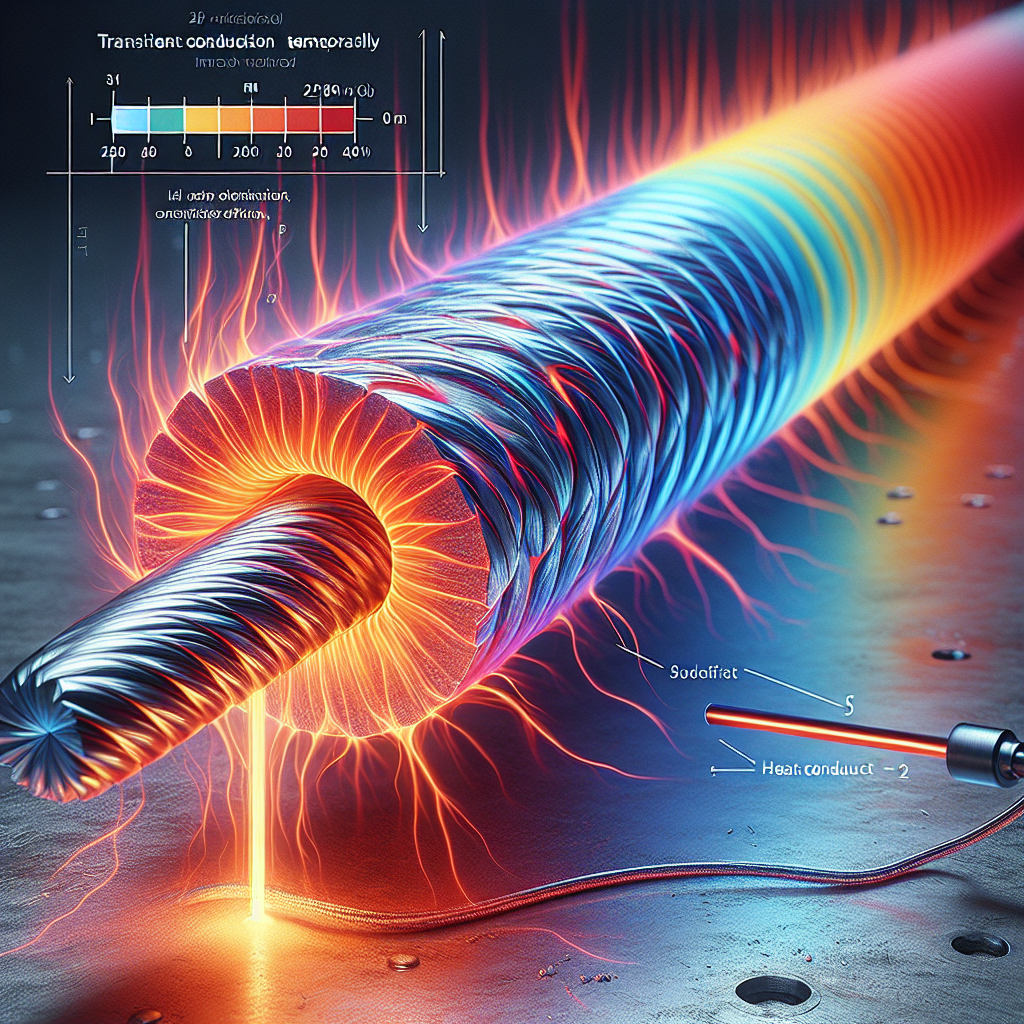
In the realm of heat transfer, transient conduction is a critical concept that engineers must understand to design efficient thermal systems. Unlike steady-state conduction, where temperature distribution does not change over time, transient conduction involves time-dependent temperature variations within a material. This phenomenon is particularly important in applications where thermal responses to changes in environmental conditions or operational states are crucial. From cooling electronic components to designing thermal protection systems for spacecraft, transient conduction plays a vital role in ensuring the reliability and efficiency of engineering systems.
Fundamentals
Basic Principles and Concepts
Transient conduction, also known as unsteady-state conduction, occurs when the temperature within a material changes with time. This time-dependent heat transfer is governed by the heat diffusion equation, a partial differential equation derived from the conservation of energy principle. The general form of the heat diffusion equation in three dimensions is:
∂T/∂t = α (∂²T/∂x² + ∂²T/∂y² + ∂²T/∂z²)
where T is the temperature, t is time, α is the thermal diffusivity of the material, and x, y, z are spatial coordinates. Thermal diffusivity, α, is a material property defined as:
α = k / (ρc)
where k is the thermal conductivity, ρ is the density, and c is the specific heat capacity of the material.
Key Terms
- Thermal Diffusivity: A measure of how quickly heat spreads through a material.
- Biot Number (Bi): A dimensionless number that compares the internal thermal resistance within a body to the external thermal resistance due to convection.
- Fourier Number (Fo): A dimensionless number that characterizes heat conduction and is defined as Fo = αt/L², where L is a characteristic length.
Historical Development
The study of transient conduction has evolved significantly over the years, with contributions from many notable figures in the field of heat transfer. One of the earliest milestones was the formulation of Fourier’s law of heat conduction by Joseph Fourier in the early 19th century. Fourier’s work laid the foundation for understanding heat transfer processes, including transient conduction.
In the mid-20th century, advancements in computational methods and numerical analysis allowed for more accurate and complex modeling of transient heat conduction. The development of finite difference and finite element methods enabled engineers to solve the heat diffusion equation for various geometries and boundary conditions, leading to more precise predictions of temperature distributions over time.
Applications
Transient conduction is relevant in numerous engineering applications across various industries. Here are some notable examples:
Electronics Cooling
In the electronics industry, managing the thermal performance of components is crucial to prevent overheating and ensure reliability. Transient conduction analysis helps engineers design effective cooling solutions, such as heat sinks and thermal interface materials, to dissipate heat generated by electronic devices during operation.
Thermal Protection Systems
In aerospace engineering, transient conduction is essential for designing thermal protection systems for spacecraft re-entering the Earth’s atmosphere. These systems must withstand extreme temperature changes over short periods, and accurate transient heat transfer analysis is vital to ensure the safety and integrity of the spacecraft.
Food Processing
In the food industry, transient conduction is used to model the heating and cooling processes during food preparation and preservation. Understanding how heat penetrates food products over time helps optimize cooking times, improve food safety, and enhance product quality.
Building Insulation
In civil engineering, transient conduction analysis is applied to evaluate the thermal performance of building materials and insulation systems. This helps in designing energy-efficient buildings that maintain comfortable indoor temperatures while minimizing energy consumption.
Advanced Topics
Recent Research and Innovations
Recent advancements in transient conduction research have focused on developing more accurate and efficient computational methods. For instance, researchers are exploring machine learning algorithms to predict transient heat transfer behavior in complex systems. These algorithms can significantly reduce computational time while maintaining high accuracy.
Another area of innovation is the development of advanced materials with tailored thermal properties. For example, phase change materials (PCMs) can absorb and release large amounts of heat during phase transitions, making them ideal for applications requiring thermal energy storage and regulation.
Future Trends
Future trends in transient conduction research are likely to focus on integrating multi-physics simulations, where heat transfer is coupled with other physical phenomena such as fluid flow, electromagnetic fields, and chemical reactions. This holistic approach will provide a more comprehensive understanding of thermal systems and enable the design of more efficient and robust engineering solutions.
Challenges and Considerations
Challenges
One of the primary challenges in transient conduction analysis is the complexity of solving the heat diffusion equation for real-world applications. The equation often requires numerical methods and significant computational resources, especially for three-dimensional problems with complex geometries and boundary conditions.
Another challenge is accurately determining the thermal properties of materials, which can vary with temperature, phase changes, and other factors. Inaccurate material properties can lead to erroneous predictions and suboptimal designs.
Considerations
When conducting transient conduction analysis, engineers must consider the initial and boundary conditions of the system. These conditions significantly influence the temperature distribution and heat transfer behavior over time. Additionally, the choice of numerical methods and computational tools can impact the accuracy and efficiency of the analysis.
Potential Solutions
To address these challenges, researchers are developing more sophisticated numerical methods and algorithms that can handle complex geometries and boundary conditions more efficiently. Additionally, advancements in material science are leading to the development of materials with more predictable and stable thermal properties.
Further research is also needed to improve the accuracy of experimental techniques for measuring thermal properties and validating computational models. This will enhance the reliability of transient conduction analysis and its applications in various industries.
Conclusion
Transient conduction is a fundamental concept in the field of heat transfer in engineering, with significant implications for the design and optimization of thermal systems. Understanding the principles and applications of transient conduction is essential for engineers working in diverse industries, from electronics cooling to aerospace engineering. While challenges remain in accurately modeling and predicting transient heat transfer behavior, ongoing research and innovations are paving the way for more efficient and reliable solutions. As technology continues to advance, the importance of transient conduction in engineering will only grow, underscoring its relevance and impact in the field of heat transfer.