Convection Heat Transfer: Newton’s Law of Cooling
Introduction
Convection heat transfer is a fundamental concept in the field of heat transfer in engineering, playing a crucial role in various industrial processes and applications. One of the key principles governing convection heat transfer is Newton’s Law of Cooling. This law provides a mathematical framework for understanding how heat is transferred between a solid surface and a fluid in motion. The relevance of this topic extends across multiple engineering disciplines, including mechanical, chemical, and civil engineering, making it essential for engineers to grasp its principles and applications.
Fundamentals
Basic Principles and Concepts
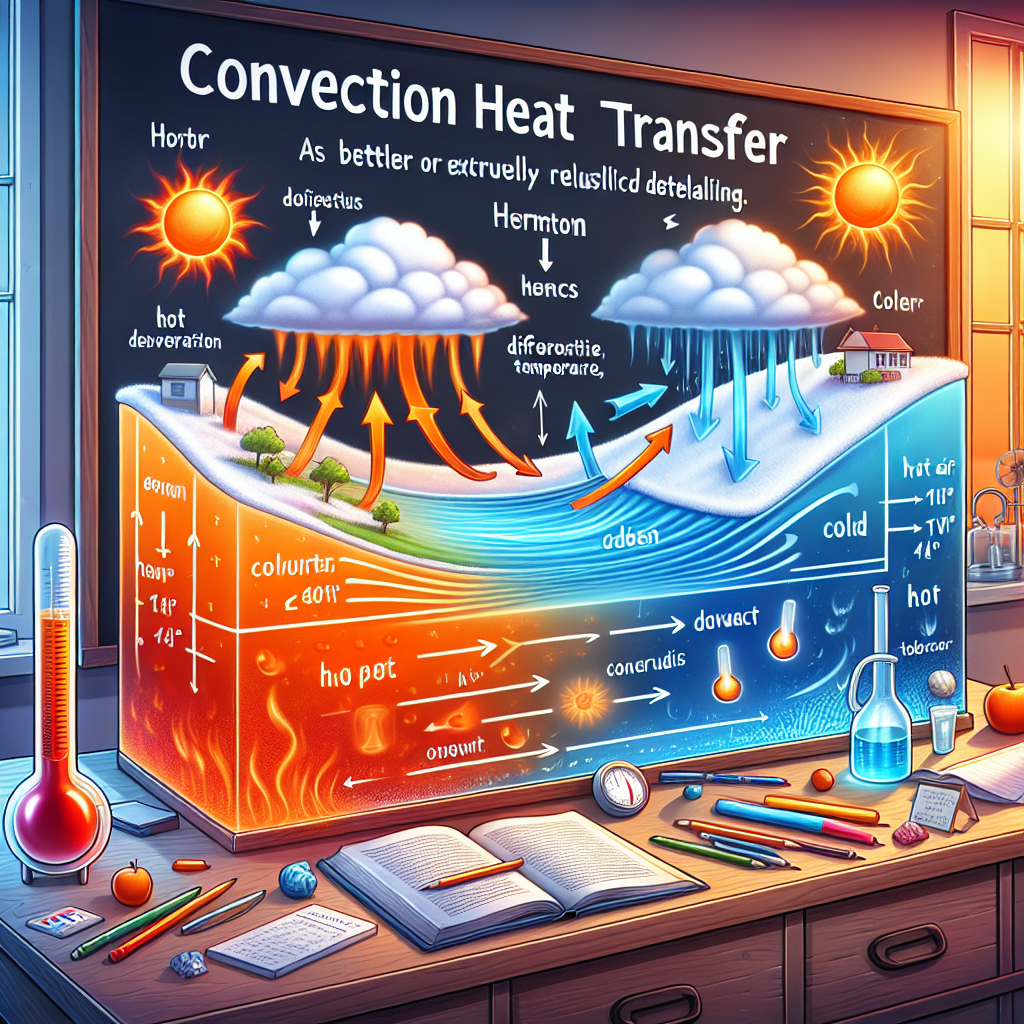
Convection heat transfer involves the transfer of heat between a solid surface and a fluid (liquid or gas) that is in motion. This process can be categorized into two types: natural convection and forced convection. In natural convection, the fluid motion is induced by buoyancy forces that result from density variations due to temperature differences within the fluid. In forced convection, the fluid motion is generated by external means, such as a pump or a fan.
Newton’s Law of Cooling
Newton’s Law of Cooling states that the rate of heat transfer between a solid surface and a fluid is proportional to the difference in temperature between the surface and the fluid. Mathematically, it is expressed as:
Q = hA(T_s – T_f)
Where:
- Q is the rate of heat transfer (W).
- h is the convective heat transfer coefficient (W/m²·K).
- A is the surface area through which heat is being transferred (m²).
- T_s is the temperature of the solid surface (K).
- T_f is the temperature of the fluid (K).
The convective heat transfer coefficient, h, is a crucial parameter that depends on various factors, including the properties of the fluid, the nature of the fluid flow, and the characteristics of the solid surface.
Historical Development
Early Discoveries
The concept of heat transfer has been studied for centuries, with early contributions from scientists such as Sir Isaac Newton, who formulated Newton’s Law of Cooling in the late 17th century. Newton’s work laid the foundation for understanding the relationship between temperature differences and heat transfer rates.
Advancements in the 19th and 20th Centuries
In the 19th century, significant advancements were made in the field of thermodynamics and heat transfer. Notable figures such as Jean-Baptiste Joseph Fourier and Ludwig Prandtl made substantial contributions. Fourier’s work on heat conduction and Prandtl’s development of boundary layer theory provided deeper insights into the mechanisms of heat transfer.
In the 20th century, the development of computational methods and experimental techniques further advanced the understanding of convection heat transfer. Researchers such as Theodore von Kármán and Ernst Schmidt made significant contributions to the study of fluid dynamics and heat transfer, leading to more accurate models and predictions.
Applications
Industrial Applications
Convection heat transfer is critical in various industrial applications, including:
- Heat Exchangers: Used in power plants, chemical processing, and HVAC systems to transfer heat between fluids.
- Cooling Systems: Employed in automotive engines, electronic devices, and industrial machinery to dissipate heat and maintain optimal operating temperatures.
- Boilers and Furnaces: Utilized in energy production and manufacturing processes to transfer heat to fluids or materials.
Case Studies
One notable example is the use of convection heat transfer in the design of heat exchangers for power plants. Efficient heat exchangers are essential for maximizing energy transfer and minimizing energy losses. By optimizing the convective heat transfer coefficient and surface area, engineers can enhance the performance and efficiency of these systems.
Another example is the cooling of electronic devices. As electronic components become smaller and more powerful, effective heat dissipation becomes increasingly important. Advanced cooling techniques, such as liquid cooling and heat pipes, rely on convection heat transfer principles to maintain safe operating temperatures and prevent overheating.
Advanced Topics
Recent Research and Innovations
Recent research in convection heat transfer has focused on enhancing heat transfer rates and developing new materials and technologies. Some of the advanced topics include:
- Nanofluids: Fluids containing nanoparticles that exhibit enhanced thermal properties, leading to improved heat transfer performance.
- Microchannel Heat Sinks: Miniaturized heat exchangers with high surface area-to-volume ratios, used in electronic cooling and microfluidic devices.
- Phase Change Materials (PCMs): Materials that absorb or release heat during phase transitions, providing efficient thermal management solutions.
Future Trends
The future of convection heat transfer research is likely to focus on developing more efficient and sustainable technologies. This includes exploring new materials with superior thermal properties, optimizing heat exchanger designs, and integrating advanced cooling techniques into various applications. Additionally, the use of computational fluid dynamics (CFD) and machine learning algorithms is expected to enhance the accuracy and efficiency of heat transfer models and simulations.
Challenges and Considerations
Challenges
Despite the advancements in convection heat transfer, several challenges remain:
- Complexity of Fluid Flow: Understanding and predicting fluid flow behavior, especially in turbulent regimes, can be challenging and requires sophisticated models and simulations.
- Material Limitations: The performance of heat transfer systems is often limited by the thermal properties of materials. Developing new materials with enhanced thermal conductivity and stability is an ongoing challenge.
- Scaling Issues: Scaling up laboratory-scale heat transfer solutions to industrial applications can be difficult due to differences in operating conditions and system complexities.
Potential Solutions
To address these challenges, researchers are exploring various approaches:
- Advanced Modeling Techniques: Utilizing CFD and other computational methods to improve the accuracy of heat transfer predictions and optimize system designs.
- Material Innovation: Developing new materials, such as nanocomposites and advanced alloys, with superior thermal properties and durability.
- Experimental Validation: Conducting extensive experimental studies to validate theoretical models and ensure the reliability of heat transfer solutions in real-world applications.
Conclusion
Convection heat transfer, governed by Newton’s Law of Cooling, is a fundamental concept in the field of heat transfer in engineering. Its principles are essential for understanding and optimizing various industrial processes and applications, from heat exchangers and cooling systems to boilers and electronic devices. The historical development of this topic has been marked by significant contributions from notable figures, leading to a deeper understanding of fluid dynamics and heat transfer mechanisms.
Recent research and innovations have focused on enhancing heat transfer rates and developing new materials and technologies, with future trends likely to emphasize efficiency and sustainability. Despite the challenges associated with fluid flow complexity, material limitations, and scaling issues, ongoing research and advanced modeling techniques offer potential solutions and areas for further exploration.
In conclusion, convection heat transfer remains a critical area of study in engineering, with wide-ranging applications and significant implications for various industries. Understanding and optimizing this process is essential for improving the performance and efficiency of heat transfer systems, ultimately contributing to advancements in technology and industry.