Robotics in Underwater Exploration
Introduction
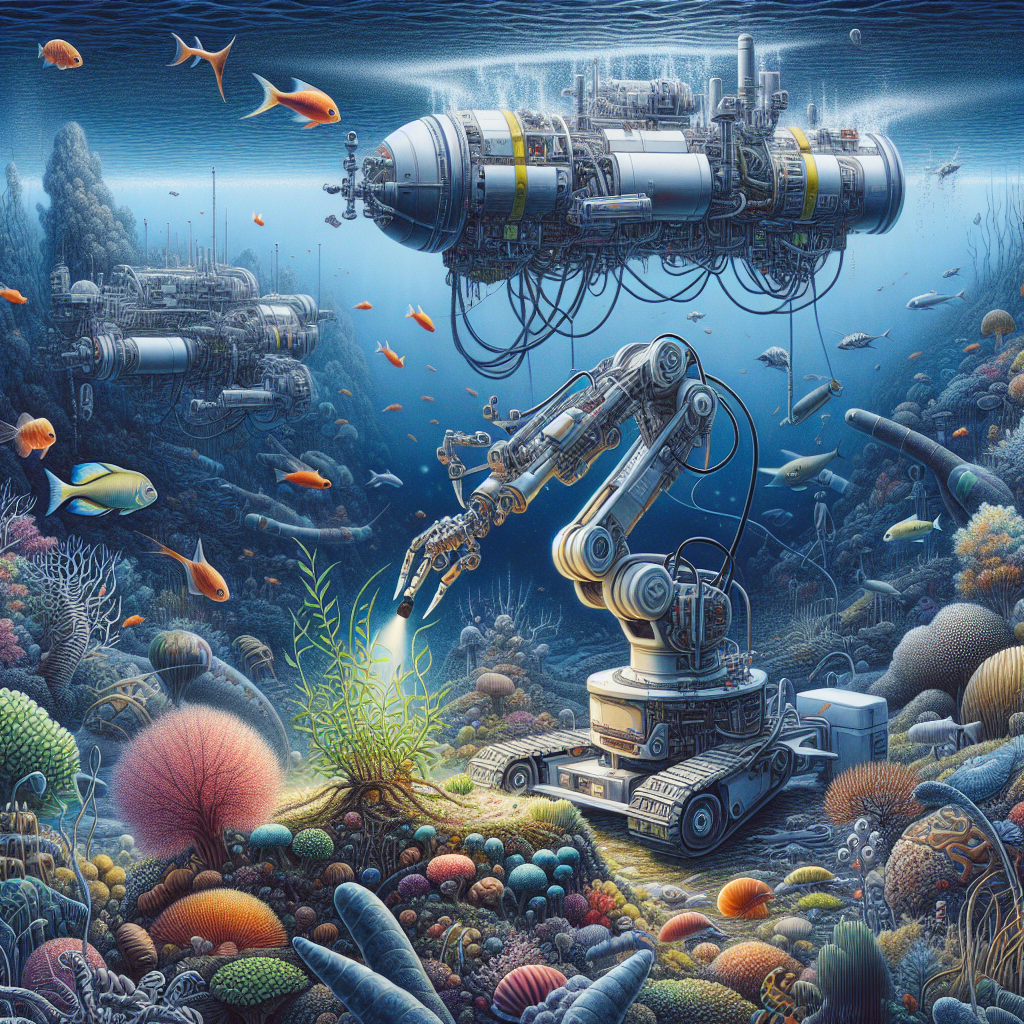
Robotics in underwater exploration represents a fascinating and rapidly evolving field within engineering. The vast and largely uncharted underwater world holds immense potential for scientific discovery, resource extraction, environmental monitoring, and even military applications. The development and deployment of underwater robots, also known as Autonomous Underwater Vehicles (AUVs) and Remotely Operated Vehicles (ROVs), have revolutionized our ability to explore and understand the ocean’s depths. This article delves into the importance, principles, historical development, applications, advanced topics, challenges, and future trends of robotics in underwater exploration.
Fundamentals
Basic Principles and Concepts
Underwater robotics involves the design, construction, and operation of robots capable of functioning in aquatic environments. These robots are engineered to withstand high pressure, low temperatures, and limited visibility, making them suitable for deep-sea exploration. Key terms and concepts in this field include:
- Autonomous Underwater Vehicles (AUVs): These are self-guided robots that operate without real-time human control. They are pre-programmed with specific tasks and can navigate underwater using sensors and onboard processing systems.
- Remotely Operated Vehicles (ROVs): These robots are controlled by operators on the surface via a tether or cable. They are equipped with cameras, sensors, and manipulators to perform various tasks.
- Sonar: Sound Navigation and Ranging (sonar) is a technique that uses sound waves to detect and map underwater objects and terrain.
- Buoyancy Control: The ability of a robot to adjust its buoyancy to ascend, descend, or maintain a specific depth.
- Hydrodynamics: The study of fluids in motion, which is crucial for designing underwater robots that can move efficiently through water.
Historical Development
Early Innovations
The history of underwater robotics dates back to the mid-20th century. One of the earliest milestones was the development of the Bathyscaphe Trieste, a manned submersible that reached the Challenger Deep in the Mariana Trench in 1960. This achievement demonstrated the potential for deep-sea exploration and paved the way for robotic advancements.
Key Milestones
- 1960s-1970s: The development of the first ROVs, such as the CURV (Cable-controlled Underwater Recovery Vehicle), which was used for underwater salvage operations.
- 1980s: The introduction of AUVs, with early models like the MIT Sea Grant AUV, which showcased the potential for autonomous underwater exploration.
- 1990s: Advances in sensor technology and computing power led to more sophisticated AUVs and ROVs, capable of complex tasks such as underwater mapping and inspection.
- 2000s-Present: The integration of artificial intelligence (AI) and machine learning (ML) has further enhanced the capabilities of underwater robots, enabling them to perform more autonomous and intelligent operations.
Applications
Scientific Research
Underwater robots have become indispensable tools for marine scientists. They are used to study marine ecosystems, map the seafloor, and monitor environmental changes. For example, the AUV Sentry has been used to explore hydrothermal vents and collect data on deep-sea biodiversity.
Resource Exploration
The oil and gas industry relies heavily on ROVs for underwater inspections, maintenance, and repair of offshore platforms and pipelines. AUVs are also used for seabed mapping and resource surveys, aiding in the discovery of new oil and gas reserves.
Environmental Monitoring
Underwater robots play a crucial role in monitoring water quality, pollution levels, and the health of marine habitats. They can collect samples, measure parameters such as temperature and salinity, and provide real-time data for environmental assessments.
Military and Defense
The military uses underwater robots for mine detection, surveillance, and reconnaissance missions. AUVs like the Bluefin-21 have been deployed for search and recovery operations, including the search for the missing Malaysia Airlines Flight MH370.
Case Studies
One notable case study is the use of the ROV Hercules in the exploration of the Titanic wreck. Equipped with high-definition cameras and manipulator arms, Hercules provided detailed images and conducted scientific investigations at the site.
Advanced Topics
Artificial Intelligence and Machine Learning
Recent advancements in AI and ML have significantly enhanced the capabilities of underwater robots. These technologies enable robots to make real-time decisions, adapt to changing environments, and perform complex tasks autonomously. For instance, AI algorithms can be used to identify and classify marine species from video footage captured by AUVs.
Swarm Robotics
Swarm robotics involves the coordination of multiple robots to perform tasks collectively. In underwater exploration, swarm robotics can be used for large-scale mapping, environmental monitoring, and search and rescue operations. This approach offers increased efficiency and redundancy compared to single-robot systems.
Bio-inspired Robotics
Researchers are increasingly looking to nature for inspiration in designing underwater robots. Bio-inspired robots mimic the locomotion and behavior of marine organisms, such as fish and octopuses, to achieve more efficient and agile movement. Examples include the RoboFish and the Octobot.
Recent Innovations
Recent innovations in underwater robotics include the development of hybrid AUV/ROV systems, which combine the autonomy of AUVs with the versatility of ROVs. These systems can operate autonomously for extended periods and switch to tethered mode for more complex tasks.
Challenges and Considerations
Technical Challenges
Underwater exploration presents several technical challenges, including:
- Communication: Radio waves do not propagate well underwater, making real-time communication with underwater robots challenging. Acoustic communication is commonly used but has limited bandwidth and range.
- Navigation: GPS signals do not penetrate water, requiring alternative navigation methods such as inertial navigation systems (INS) and Doppler velocity logs (DVL).
- Energy Supply: Powering underwater robots for extended missions is a significant challenge. Advances in battery technology and energy harvesting are crucial for improving endurance.
Environmental Considerations
Underwater robots must be designed to minimize their impact on marine ecosystems. This includes reducing noise pollution, avoiding physical damage to habitats, and ensuring that robots do not introduce contaminants into the environment.
Potential Solutions
Addressing these challenges requires ongoing research and innovation. Potential solutions include:
- Developing more efficient acoustic communication systems.
- Improving navigation algorithms and integrating multiple sensor modalities.
- Advancing battery technology and exploring alternative energy sources such as fuel cells and ocean thermal energy conversion (OTEC).
Conclusion
Robotics in underwater exploration is a dynamic and rapidly advancing field that holds immense promise for scientific discovery, resource extraction, environmental monitoring, and defense applications. The development of AUVs and ROVs has revolutionized our ability to explore and understand the ocean’s depths. While significant challenges remain, ongoing research and innovation continue to push the boundaries of what is possible. As we look to the future, the integration of AI, swarm robotics, and bio-inspired designs will further enhance the capabilities of underwater robots, opening new frontiers in the exploration of our planet’s final frontier.
In conclusion, the importance of robotics in underwater exploration cannot be overstated. It represents a critical intersection of engineering, science, and technology, with far-reaching implications for our understanding of the natural world and our ability to harness its resources sustainably. As we continue to explore the depths of the ocean, underwater robots will undoubtedly play a pivotal role in unlocking its mysteries and addressing the challenges of the 21st century.