Radiation Heat Transfer between Surfaces
Introduction
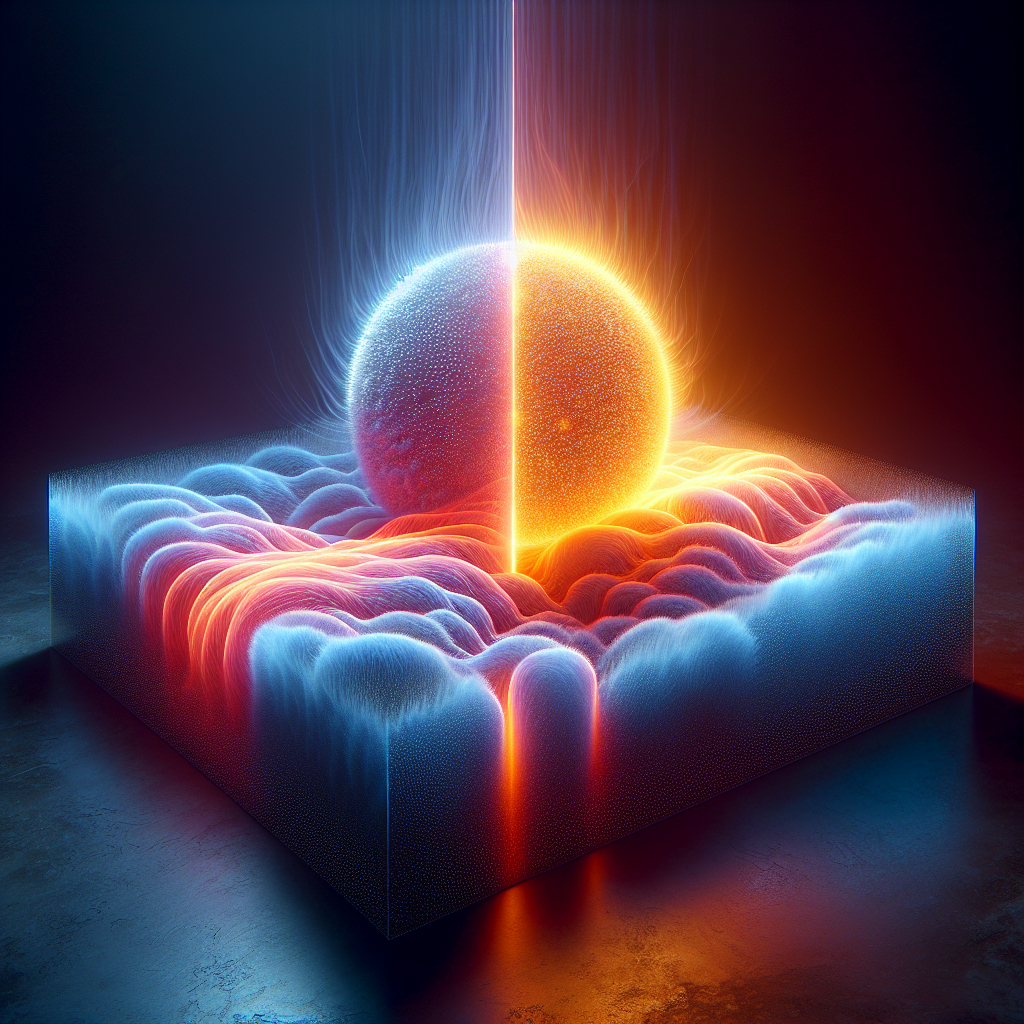
Radiation heat transfer between surfaces is a critical aspect of heat transfer in engineering, playing a significant role in various industrial applications and scientific research. Unlike conduction and convection, which require a medium to transfer heat, radiation can occur through a vacuum, making it essential for understanding thermal processes in space, high-temperature environments, and advanced engineering systems. This article delves into the importance, principles, historical development, applications, advanced topics, challenges, and future trends of radiation heat transfer between surfaces.
Fundamentals
Basic Principles and Concepts
Radiation heat transfer is the process by which thermal energy is emitted by a surface and transferred through electromagnetic waves. The fundamental principles governing this process are rooted in the laws of thermodynamics and electromagnetic theory.
Key Terms and Definitions
- Emissivity: A measure of a material’s ability to emit thermal radiation compared to a perfect blackbody.
- Blackbody: An idealized surface that absorbs all incident radiation and emits the maximum possible radiation at a given temperature.
- Stefan-Boltzmann Law: States that the total energy radiated per unit surface area of a blackbody is proportional to the fourth power of its absolute temperature.
- Planck’s Law: Describes the spectral density of electromagnetic radiation emitted by a blackbody in thermal equilibrium at a given temperature.
- View Factor: The fraction of radiation leaving one surface that directly reaches another surface.
Theories
The Stefan-Boltzmann Law is given by:
Q = εσAT4
where Q is the radiative heat transfer, ε is the emissivity, σ is the Stefan-Boltzmann constant, A is the surface area, and T is the absolute temperature.
Planck’s Law is expressed as:
E(λ, T) = (2πhc2/λ5)(1/(ehc/λkT – 1))
where E(λ, T) is the spectral radiance, h is Planck’s constant, c is the speed of light, λ is the wavelength, and k is Boltzmann’s constant.
Historical Development
Early Discoveries
The study of radiation heat transfer dates back to the 19th century with the work of scientists like Gustav Kirchhoff, who formulated Kirchhoff’s Law of Thermal Radiation, and Josef Stefan, who empirically derived the Stefan-Boltzmann Law. Ludwig Boltzmann later provided a theoretical foundation for Stefan’s findings.
Key Milestones
- 1859: Gustav Kirchhoff introduces Kirchhoff’s Law of Thermal Radiation.
- 1879: Josef Stefan empirically derives the Stefan-Boltzmann Law.
- 1900: Max Planck formulates Planck’s Law, laying the groundwork for quantum theory.
- 1923: Arthur H. Compton demonstrates the particle nature of electromagnetic radiation, furthering the understanding of radiation heat transfer.
Notable Figures
- Gustav Kirchhoff: Known for Kirchhoff’s Law of Thermal Radiation.
- Josef Stefan: Empirically derived the Stefan-Boltzmann Law.
- Ludwig Boltzmann: Provided the theoretical basis for the Stefan-Boltzmann Law.
- Max Planck: Formulated Planck’s Law, a cornerstone of quantum mechanics.
Applications
Industrial Applications
Radiation heat transfer is crucial in various industrial applications, including:
- Furnace Design: Optimizing heat transfer in high-temperature furnaces used in metal processing and ceramics.
- Thermal Insulation: Designing materials and coatings to minimize radiative heat loss in buildings and spacecraft.
- Solar Energy: Enhancing the efficiency of solar panels and thermal collectors by understanding and optimizing radiative properties.
Case Studies
One notable case study involves the design of the heat shield for the Mars Rover. Engineers had to account for radiative heat transfer to ensure the rover’s instruments remained within operational temperatures during entry, descent, and landing.
Advanced Topics
Recent Research and Innovations
Recent advancements in nanotechnology and materials science have led to the development of metamaterials with tailored radiative properties. These materials can manipulate electromagnetic waves in ways that were previously impossible, opening new avenues for controlling radiative heat transfer.
Future Trends
Future research is likely to focus on:
- Nanostructured Surfaces: Developing surfaces with nanoscale features to enhance or suppress radiative heat transfer.
- Smart Materials: Creating materials that can dynamically change their radiative properties in response to environmental conditions.
- Space Applications: Improving thermal management systems for spacecraft and satellites.
Challenges and Considerations
Challenges
Despite its importance, radiation heat transfer presents several challenges:
- Complex Calculations: Accurately modeling radiative heat transfer requires solving complex integral equations, often necessitating advanced computational methods.
- Material Properties: Determining the radiative properties of materials at high temperatures can be difficult and requires precise measurements.
- Environmental Factors: External factors such as atmospheric conditions can significantly affect radiative heat transfer, complicating predictions and designs.
Potential Solutions
To address these challenges, researchers are exploring:
- Advanced Computational Techniques: Utilizing machine learning and artificial intelligence to improve the accuracy and efficiency of radiative heat transfer models.
- High-Temperature Materials: Developing new materials with well-characterized radiative properties at extreme temperatures.
- Experimental Methods: Enhancing experimental techniques to better measure and understand radiative properties under various conditions.
Conclusion
Radiation heat transfer between surfaces is a fundamental aspect of heat transfer in engineering, with wide-ranging applications in industries such as aerospace, energy, and manufacturing. Understanding the principles, historical development, and practical applications of this phenomenon is crucial for advancing technology and improving thermal management systems. While challenges remain, ongoing research and innovations promise to unlock new possibilities and enhance our ability to control and utilize radiative heat transfer effectively. As we continue to explore the frontiers of science and engineering, the importance of radiation heat transfer will only grow, underscoring its vital role in shaping the future of technology.