Compressible Flow and Shock Waves
Introduction
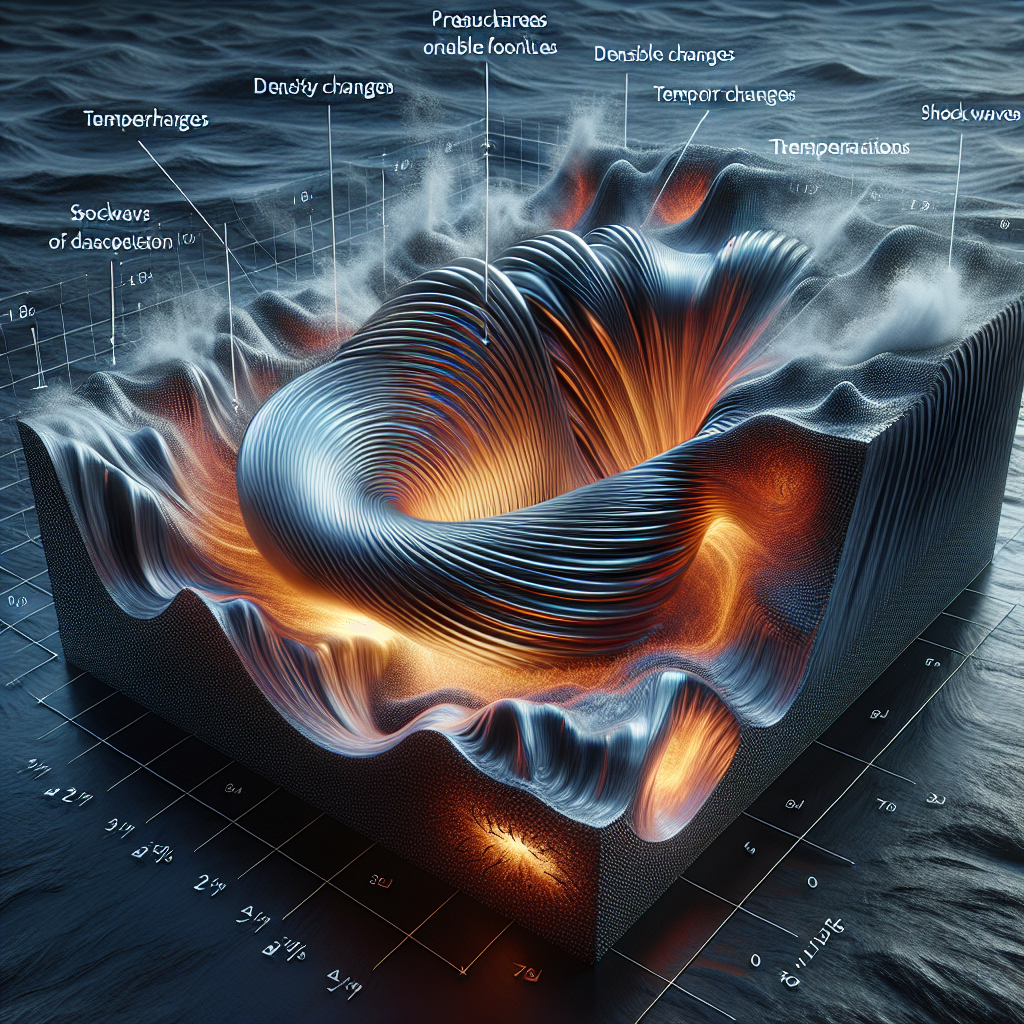
In the realm of fluid dynamics, the study of compressible flow and shock waves holds a pivotal position. These phenomena are crucial in understanding the behavior of gases under varying pressure and temperature conditions, which is essential for numerous engineering applications. From the design of high-speed aircraft and rockets to the development of efficient combustion engines, the principles of compressible flow and shock waves are integral to advancing technology and innovation. This article delves into the fundamental concepts, historical development, practical applications, advanced topics, and challenges associated with compressible flow and shock waves in engineering.
Fundamentals
Basic Principles and Concepts
Compressible flow refers to the type of fluid flow where the fluid density changes significantly in response to pressure variations. This is in contrast to incompressible flow, where the density remains nearly constant. Compressible flow is typically associated with gases, as liquids are generally considered incompressible due to their relatively constant density.
Key Terms and Definitions
- Mach Number (M): A dimensionless quantity representing the ratio of the flow velocity to the speed of sound in the medium. It is a critical parameter in compressible flow analysis.
- Shock Wave: A type of propagating disturbance characterized by an abrupt, nearly discontinuous change in pressure, temperature, and density of the medium. Shock waves occur when the flow velocity exceeds the speed of sound.
- Isentropic Flow: A flow process that is both adiabatic (no heat transfer) and reversible, meaning there is no entropy change.
- Choked Flow: A condition where the flow rate is limited by the sonic condition at the throat of a nozzle, meaning the Mach number is equal to one.
Theories and Equations
The study of compressible flow is governed by several fundamental equations and principles:
- Continuity Equation: Ensures mass conservation in a flow system.
- Momentum Equation: Derived from Newton’s second law, it accounts for the forces acting on a fluid element.
- Energy Equation: Represents the conservation of energy in the flow, incorporating internal energy, kinetic energy, and work done by pressure forces.
- Equation of State: Relates the pressure, temperature, and density of a gas, typically represented by the ideal gas law for many engineering applications.
Historical Development
The study of compressible flow and shock waves has a rich history, marked by significant contributions from various scientists and engineers.
Early Discoveries
The concept of sound waves and their propagation in gases was first studied by Sir Isaac Newton in the 17th century. However, it was not until the 19th century that the foundations of compressible flow theory were laid. The work of Ernst Mach, an Austrian physicist, was particularly influential. Mach’s experiments with supersonic projectiles led to the identification of the Mach number, a fundamental parameter in compressible flow.
20th Century Advances
The development of high-speed aircraft and rockets during the 20th century spurred significant advancements in the understanding of compressible flow and shock waves. The work of Theodore von Kármán, a Hungarian-American engineer, and John von Neumann, a Hungarian-American mathematician, was instrumental in developing the theoretical framework for shock waves and supersonic flow. Their contributions laid the groundwork for modern aerodynamics and fluid dynamics.
Applications
Compressible flow and shock waves have a wide range of practical applications across various industries.
Aerospace Engineering
In aerospace engineering, the design of high-speed aircraft, missiles, and spacecraft relies heavily on the principles of compressible flow. The behavior of air at supersonic and hypersonic speeds, the formation of shock waves, and the associated aerodynamic heating are critical considerations in ensuring the performance and safety of these vehicles.
Combustion Engines
Compressible flow is also essential in the design and optimization of combustion engines. In internal combustion engines, the intake and exhaust processes involve compressible flow, and understanding shock waves can help improve engine efficiency and performance. Similarly, in gas turbines and jet engines, the principles of compressible flow are crucial for designing efficient compressors and turbines.
Industrial Processes
Various industrial processes, such as gas pipelines, chemical reactors, and high-speed manufacturing, involve compressible flow. For instance, in gas pipelines, understanding the behavior of compressible flow can help optimize the transport of natural gas and other fluids, ensuring efficient and safe operation.
Case Studies
One notable case study is the design of the Concorde, a supersonic passenger aircraft. The engineers had to account for compressible flow effects, such as shock waves and aerodynamic heating, to ensure the aircraft’s performance and safety. Another example is the development of the Space Shuttle, where the re-entry phase involves compressible flow and shock waves, requiring careful thermal protection system design to withstand the extreme conditions.
Advanced Topics
As research in fluid dynamics continues to evolve, several advanced concepts and techniques have emerged in the study of compressible flow and shock waves.
Computational Fluid Dynamics (CFD)
Computational Fluid Dynamics (CFD) has revolutionized the study of compressible flow. Advanced numerical methods and high-performance computing allow engineers to simulate complex flow phenomena, including shock waves, with high accuracy. CFD tools are now integral to the design and optimization of aerospace vehicles, engines, and industrial processes.
Hypersonic Flow
Hypersonic flow, characterized by Mach numbers greater than five, presents unique challenges and opportunities. The study of hypersonic flow is critical for developing next-generation aerospace vehicles, such as hypersonic missiles and spaceplanes. Recent research focuses on understanding the complex interactions between shock waves, boundary layers, and thermal effects at hypersonic speeds.
Shock Wave-Boundary Layer Interaction
The interaction between shock waves and boundary layers is a complex phenomenon with significant implications for aerodynamic performance and heat transfer. Recent studies aim to understand and mitigate adverse effects, such as flow separation and increased drag, through advanced experimental techniques and CFD simulations.
Future Trends
Future research in compressible flow and shock waves is likely to focus on several key areas:
- Advanced Materials: Developing materials that can withstand extreme conditions associated with shock waves and high-speed flow.
- Multiphase Flow: Understanding the behavior of compressible flow involving multiple phases, such as gas-liquid interactions in propulsion systems.
- Environmental Impact: Investigating the environmental impact of high-speed vehicles and developing sustainable solutions.
Challenges and Considerations
Despite significant advancements, several challenges and considerations remain in the study of compressible flow and shock waves.
Complexity of Flow Phenomena
The behavior of compressible flow and shock waves is inherently complex, involving nonlinear interactions and rapid changes in flow properties. Accurately predicting and controlling these phenomena requires advanced mathematical models and experimental techniques.
Experimental Limitations
Conducting experiments at high speeds and extreme conditions poses significant challenges. Wind tunnels and shock tubes are commonly used, but they have limitations in terms of scale, cost, and accuracy. Developing new experimental methods and facilities is essential for advancing our understanding of compressible flow.
Numerical Challenges
While CFD has made significant strides, accurately simulating compressible flow and shock waves remains computationally intensive. High-fidelity simulations require substantial computational resources and advanced numerical techniques to capture the intricate details of flow phenomena.
Potential Solutions
Addressing these challenges requires a multidisciplinary approach, combining theoretical research, experimental studies, and computational advancements. Collaboration between academia, industry, and government agencies is essential for developing innovative solutions and pushing the boundaries of our understanding.
Conclusion
Compressible flow and shock waves are fundamental concepts in fluid dynamics with wide-ranging applications in engineering. From aerospace engineering to industrial processes, understanding these phenomena is crucial for designing efficient and high-performance systems. While significant progress has been made, ongoing research and innovation are essential for addressing the challenges and unlocking new possibilities. As we continue to explore the complexities of compressible flow, we pave the way for advancements that will shape the future of engineering and technology.