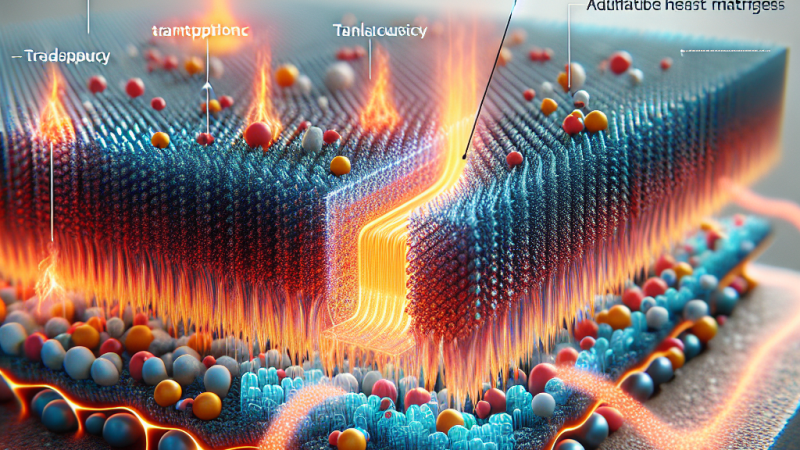
Applications of Heat Transfer in Product Design
Introduction

Heat transfer is a fundamental concept in engineering that plays a crucial role in the design and development of various products. It involves the movement of thermal energy from one object or material to another, driven by temperature differences. Understanding and controlling heat transfer is essential for optimizing the performance, efficiency, and safety of engineered systems. This article delves into the applications of heat transfer in product design, highlighting its importance and relevance in the field of engineering.
Fundamentals
Basic Principles and Concepts
Heat transfer occurs through three primary mechanisms: conduction, convection, and radiation. Each mechanism operates under different principles and is influenced by various factors.
- Conduction: This is the transfer of heat through a solid material due to the vibration and movement of molecules. The rate of conduction is governed by Fourier’s Law, which states that the heat transfer rate is proportional to the temperature gradient and the material’s thermal conductivity.
- Convection: This involves the transfer of heat between a solid surface and a fluid (liquid or gas) in motion. Newton’s Law of Cooling describes the convective heat transfer rate, which depends on the temperature difference, the surface area, and the convective heat transfer coefficient.
- Radiation: This is the transfer of heat through electromagnetic waves, primarily in the infrared spectrum. Stefan-Boltzmann Law governs radiative heat transfer, which is proportional to the fourth power of the absolute temperature of the emitting surface.
Key Terms
- Thermal Conductivity: A measure of a material’s ability to conduct heat.
- Heat Flux: The rate of heat energy transfer per unit area.
- Thermal Resistance: The opposition to heat flow through a material or interface.
- Heat Exchanger: A device designed to transfer heat between two or more fluids.
Historical Development
The study of heat transfer has a rich history, with significant contributions from various scientists and engineers over the centuries.
Key Milestones
- Fourier’s Law (1822): Jean-Baptiste Joseph Fourier formulated the law of heat conduction, laying the foundation for modern heat transfer analysis.
- Newton’s Law of Cooling (1701): Sir Isaac Newton introduced the concept of convective heat transfer, which remains a cornerstone in thermal engineering.
- Stefan-Boltzmann Law (1879): Josef Stefan and Ludwig Boltzmann developed the law governing radiative heat transfer, crucial for understanding thermal radiation.
- Development of Heat Exchangers (20th Century): The design and optimization of heat exchangers became a focal point in industrial applications, leading to advancements in energy efficiency and process engineering.
Notable Figures
- Jean-Baptiste Joseph Fourier: Known for his pioneering work in heat conduction and the Fourier series.
- Sir Isaac Newton: Renowned for his contributions to physics, including the formulation of Newton’s Law of Cooling.
- Josef Stefan and Ludwig Boltzmann: Their work on blackbody radiation and the Stefan-Boltzmann Law significantly advanced the understanding of thermal radiation.
Applications
Heat transfer principles are applied across various industries and fields, influencing the design and performance of numerous products.
Automotive Industry
In the automotive industry, heat transfer is critical for engine cooling, climate control, and exhaust systems. Efficient heat exchangers, such as radiators and intercoolers, are designed to manage the thermal loads and ensure optimal engine performance. Additionally, advanced thermal management systems are employed to enhance fuel efficiency and reduce emissions.
Electronics and Semiconductor Industry
Heat dissipation is a major concern in the design of electronic devices and semiconductor components. Effective thermal management solutions, such as heat sinks, thermal interface materials, and liquid cooling systems, are essential to prevent overheating and ensure reliable operation. Innovations in microelectronics have led to the development of advanced cooling techniques, such as microchannel heat exchangers and thermoelectric coolers.
HVAC Systems
Heating, ventilation, and air conditioning (HVAC) systems rely on heat transfer principles to regulate indoor temperatures and maintain comfort. Heat exchangers, such as evaporators and condensers, play a vital role in the refrigeration cycle, enabling efficient heat transfer between the indoor and outdoor environments. Advanced HVAC systems incorporate energy recovery ventilators and heat pumps to enhance energy efficiency and reduce environmental impact.
Aerospace Industry
In the aerospace industry, thermal management is crucial for the performance and safety of aircraft and spacecraft. Heat transfer analysis is employed to design thermal protection systems, such as heat shields and insulation, to withstand extreme temperatures during re-entry and atmospheric flight. Additionally, advanced cooling techniques are used to manage the thermal loads in avionics and propulsion systems.
Renewable Energy
Heat transfer plays a significant role in renewable energy technologies, such as solar thermal power and geothermal energy. Solar collectors and heat exchangers are designed to capture and transfer thermal energy from the sun, enabling the generation of electricity and heating applications. In geothermal systems, heat exchangers facilitate the transfer of thermal energy from the Earth’s crust to provide sustainable heating and cooling solutions.
Advanced Topics
Recent Research and Innovations
Recent advancements in heat transfer research have led to the development of novel materials, techniques, and technologies.
- Nanofluids: These are engineered fluids containing nanoparticles that enhance thermal conductivity and heat transfer performance. Nanofluids are being explored for applications in cooling systems, heat exchangers, and thermal energy storage.
- Phase Change Materials (PCMs): PCMs absorb and release thermal energy during phase transitions, providing efficient thermal management solutions. They are used in applications such as thermal energy storage, building insulation, and electronic cooling.
- Microchannel Heat Exchangers: These compact heat exchangers feature micro-scale channels that enhance heat transfer rates and reduce pressure drops. They are employed in high-performance cooling systems for electronics, automotive, and aerospace applications.
- Thermoelectric Devices: These devices convert heat into electrical energy and vice versa, enabling efficient waste heat recovery and solid-state cooling. Advances in thermoelectric materials and device design are driving their adoption in various industries.
Future Trends
The future of heat transfer in product design is likely to be shaped by several emerging trends:
- Integration of AI and Machine Learning: Artificial intelligence and machine learning algorithms are being used to optimize heat transfer designs, predict thermal behavior, and enhance system performance.
- Advanced Manufacturing Techniques: Additive manufacturing and 3D printing are enabling the creation of complex heat exchanger geometries and customized thermal management solutions.
- Sustainable and Energy-Efficient Solutions: There is a growing emphasis on developing sustainable and energy-efficient thermal management technologies to reduce environmental impact and enhance energy conservation.
Challenges and Considerations
Despite the advancements in heat transfer technology, several challenges and considerations remain:
Challenges
- Material Limitations: The thermal properties of materials can limit the efficiency and performance of heat transfer systems. Developing new materials with enhanced thermal conductivity and stability is an ongoing challenge.
- Complex Geometries: Designing heat transfer systems for complex geometries and confined spaces can be challenging, requiring advanced modeling and simulation techniques.
- Cost and Manufacturing Constraints: The cost and manufacturability of advanced heat transfer solutions can be prohibitive, limiting their widespread adoption.
Considerations
- Thermal Management Integration: Effective thermal management requires the integration of heat transfer solutions into the overall product design, considering factors such as space, weight, and compatibility.
- Environmental Impact: The environmental impact of heat transfer systems, including energy consumption and emissions, should be considered in the design process to promote sustainability.
- Reliability and Maintenance: The reliability and maintenance requirements of heat transfer systems should be addressed to ensure long-term performance and minimize downtime.
Conclusion
Heat transfer is a critical aspect of product design in engineering, influencing the performance, efficiency, and safety of various systems. Understanding the fundamental principles, historical development, and practical applications of heat transfer is essential for engineers and designers. Recent advancements and emerging trends in heat transfer technology offer exciting opportunities for innovation and improvement. However, challenges and considerations must be addressed to fully realize the potential of heat transfer solutions. As the field continues to evolve, the importance of heat transfer in engineering will only grow, driving the development of more efficient, sustainable, and reliable products.