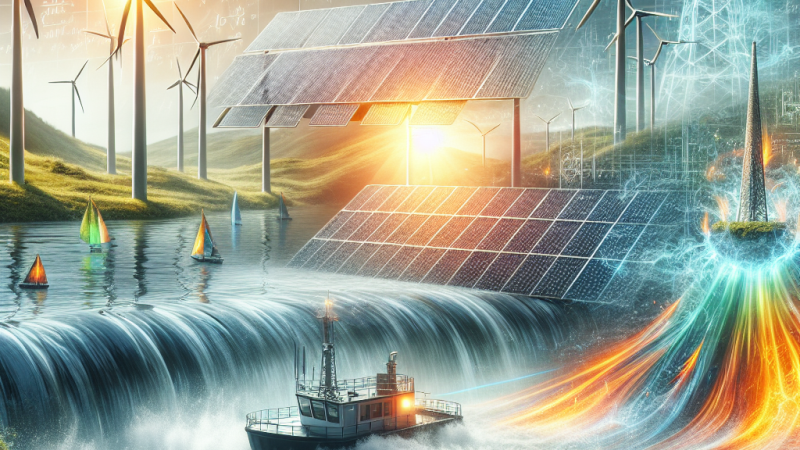
Applications in Renewable Energy Systems
Introduction

Renewable energy systems are at the forefront of the global effort to combat climate change and reduce dependence on fossil fuels. In the field of engineering, thermodynamics plays a crucial role in the design, optimization, and implementation of these systems. Thermodynamics, the study of energy, heat, and work, provides the theoretical foundation for understanding how renewable energy systems operate and how they can be made more efficient. This article delves into the applications of thermodynamics in renewable energy systems, highlighting its importance, fundamental principles, historical development, practical applications, advanced topics, challenges, and future trends.
Fundamentals
Basic Principles and Concepts
Thermodynamics is governed by four fundamental laws:
- First Law of Thermodynamics: Also known as the Law of Energy Conservation, it states that energy cannot be created or destroyed, only transformed from one form to another.
- Second Law of Thermodynamics: This law introduces the concept of entropy, stating that the total entropy of an isolated system can never decrease over time. It implies that energy transformations are not 100% efficient.
- Third Law of Thermodynamics: As the temperature of a system approaches absolute zero, the entropy of the system approaches a minimum value.
- Zeroth Law of Thermodynamics: If two systems are each in thermal equilibrium with a third system, they are in thermal equilibrium with each other.
Key terms in thermodynamics include:
- Enthalpy (H): The total heat content of a system.
- Entropy (S): A measure of the disorder or randomness in a system.
- Exergy: The maximum useful work possible during a process that brings the system into equilibrium with a heat reservoir.
- Heat Transfer: The movement of thermal energy from one object or substance to another.
Historical Development
The field of thermodynamics has a rich history, with significant contributions from numerous scientists and engineers:
- Sadi Carnot (1824): Often considered the “father of thermodynamics,” Carnot introduced the concept of the Carnot cycle, which laid the groundwork for the second law of thermodynamics.
- Rudolf Clausius (1850): Formulated the second law of thermodynamics and introduced the concept of entropy.
- James Clerk Maxwell (1860s): Developed the Maxwell relations, which are a set of equations in thermodynamics.
- Josiah Willard Gibbs (1873): Introduced the concept of free energy and the phase rule, which are fundamental to chemical thermodynamics.
These milestones have paved the way for modern applications of thermodynamics in renewable energy systems, enabling engineers to design more efficient and sustainable technologies.
Applications
Solar Energy
Thermodynamics is essential in the design and optimization of solar energy systems. Solar thermal power plants, for example, use mirrors or lenses to concentrate sunlight onto a receiver, which converts the solar energy into heat. This heat is then used to produce steam that drives a turbine connected to an electricity generator. The efficiency of these systems is governed by thermodynamic principles, particularly the second law, which dictates the maximum possible efficiency of heat engines.
Wind Energy
Wind turbines convert the kinetic energy of wind into mechanical energy, which is then transformed into electrical energy. The performance of wind turbines is analyzed using thermodynamic principles, such as the Betz limit, which defines the maximum possible efficiency of a wind turbine. Thermodynamics also helps in understanding the aerodynamic properties of turbine blades and optimizing their design for maximum energy capture.
Geothermal Energy
Geothermal power plants harness heat from the Earth’s interior to generate electricity. These plants typically use steam or hot water from geothermal reservoirs to drive turbines. Thermodynamic analysis is crucial in designing efficient geothermal systems, including the selection of working fluids, optimization of heat exchangers, and evaluation of thermodynamic cycles such as the Rankine and Kalina cycles.
Biomass Energy
Biomass energy involves converting organic materials into energy through processes such as combustion, gasification, and anaerobic digestion. Thermodynamics helps in understanding the energy content of biomass, optimizing combustion processes, and improving the efficiency of bioenergy systems. For instance, combined heat and power (CHP) systems use thermodynamic principles to simultaneously produce electricity and useful heat from biomass.
Advanced Topics
Exergy Analysis
Exergy analysis is an advanced thermodynamic technique used to evaluate the efficiency of energy systems. Unlike traditional energy analysis, which only considers the quantity of energy, exergy analysis accounts for the quality of energy and its potential to do work. This approach helps identify and minimize irreversibilities in renewable energy systems, leading to more efficient designs.
Thermoeconomic Analysis
Thermoeconomics combines thermodynamics with economic principles to assess the cost-effectiveness of energy systems. This approach considers both the thermodynamic performance and economic costs of renewable energy technologies, enabling engineers to make informed decisions about system design and optimization. Recent research in thermoeconomics focuses on integrating renewable energy sources into existing energy grids and minimizing the levelized cost of energy (LCOE).
Advanced Materials
Recent innovations in materials science have led to the development of advanced materials with superior thermal properties. For example, phase change materials (PCMs) can store and release large amounts of thermal energy, making them ideal for thermal energy storage systems. Nanomaterials, such as carbon nanotubes and graphene, exhibit exceptional thermal conductivity and are being explored for use in heat exchangers and solar collectors.
Challenges and Considerations
Efficiency and Cost
One of the primary challenges in renewable energy systems is improving efficiency while keeping costs low. Thermodynamic limitations, such as the second law, impose upper bounds on the efficiency of energy conversion processes. Engineers must balance the trade-offs between efficiency, cost, and environmental impact when designing renewable energy systems.
Intermittency and Storage
Renewable energy sources, such as solar and wind, are intermittent and do not produce energy consistently. Thermodynamic principles are used to design energy storage systems, such as batteries and thermal energy storage, to store excess energy and release it when needed. However, these storage systems face challenges related to efficiency, capacity, and cost.
Environmental Impact
While renewable energy systems are generally more environmentally friendly than fossil fuels, they are not without their environmental impacts. For example, the production and disposal of solar panels and wind turbines can generate waste and emissions. Thermodynamic analysis helps in assessing the life cycle environmental impact of renewable energy technologies and identifying ways to minimize their footprint.
Conclusion
Thermodynamics plays a pivotal role in the development and optimization of renewable energy systems. By understanding and applying thermodynamic principles, engineers can design more efficient and sustainable technologies that harness energy from renewable sources. From solar and wind to geothermal and biomass, thermodynamics provides the theoretical foundation for a wide range of applications in the renewable energy sector. Despite the challenges and limitations, ongoing research and innovations in thermodynamics hold the promise of a cleaner, more sustainable energy future. As the world continues to transition towards renewable energy, the importance of thermodynamics in engineering will only continue to grow.