Vibration Control in Mechanical Systems
Introduction
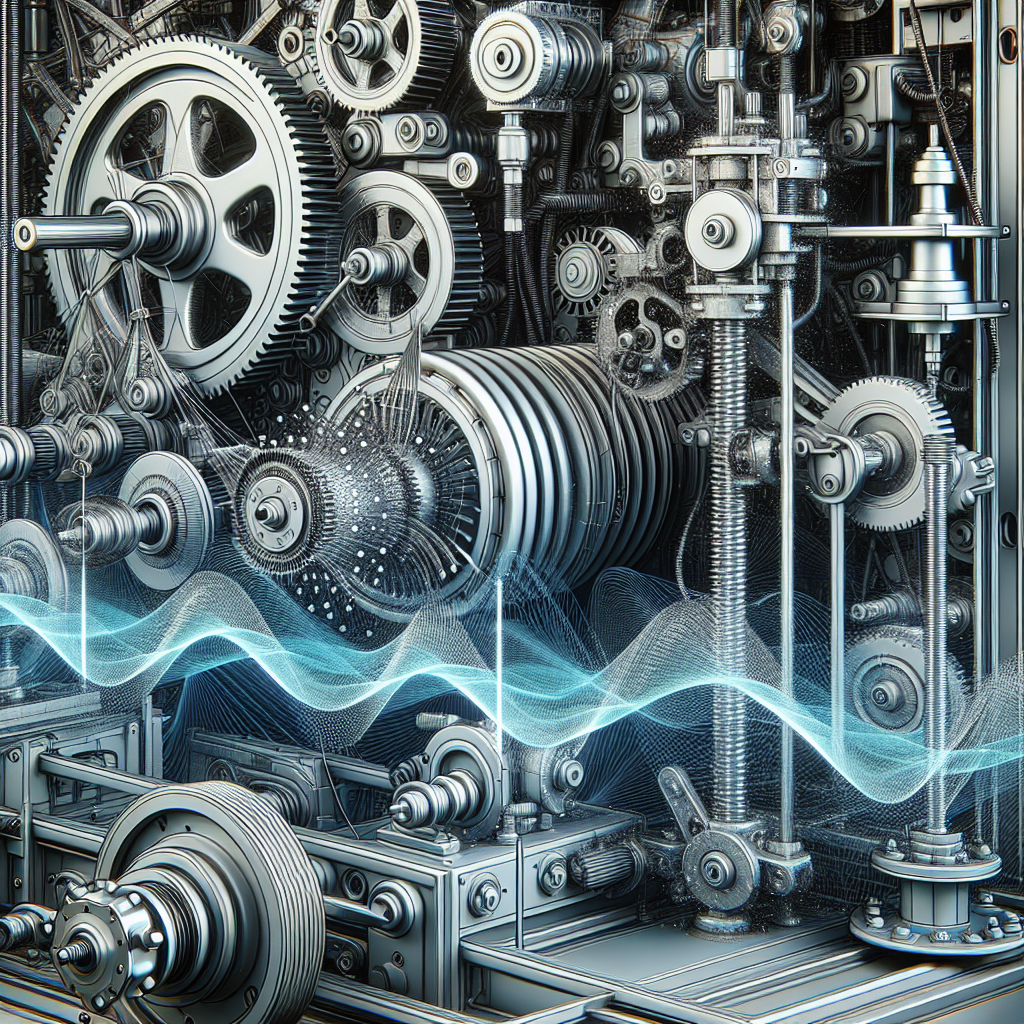
Vibration control in mechanical systems is a critical aspect of engineering that ensures the stability, efficiency, and longevity of various mechanical structures and devices. From automotive engines to aerospace components, and from industrial machinery to consumer electronics, controlling vibrations is essential to prevent damage, reduce noise, and enhance performance. This article delves into the importance and relevance of vibration control in the field of engineering, providing a comprehensive overview of its principles, historical development, applications, advanced topics, challenges, and future trends.
Fundamentals
Basic Principles and Concepts
Vibration control involves the reduction or elimination of unwanted oscillations in mechanical systems. These oscillations can be caused by various factors, including external forces, internal imbalances, and environmental conditions. The primary goal of vibration control is to minimize the amplitude and frequency of these oscillations to acceptable levels.
Key Terms and Definitions
- Amplitude: The maximum displacement of a vibrating system from its equilibrium position.
- Frequency: The number of oscillations per unit time, typically measured in Hertz (Hz).
- Damping: The process of dissipating energy from a vibrating system, usually through friction or other resistive forces.
- Resonance: A condition where the frequency of external forces matches the natural frequency of the system, leading to large amplitude oscillations.
- Natural Frequency: The frequency at which a system naturally oscillates when disturbed from its equilibrium position.
Theories and Models
Several theories and models are used to analyze and control vibrations in mechanical systems. The most common include:
- Newton’s Laws of Motion: These laws form the foundation for understanding the dynamics of vibrating systems.
- Harmonic Oscillator Model: This model describes the motion of systems that exhibit simple harmonic motion, such as springs and pendulums.
- Modal Analysis: A technique used to determine the natural frequencies and mode shapes of a system.
- Finite Element Analysis (FEA): A numerical method used to predict how a system responds to external forces, including vibrations.
Historical Development
Early Contributions
The study of vibrations dates back to ancient times, with early contributions from Greek philosophers such as Pythagoras, who explored the relationship between musical tones and vibrating strings. However, significant advancements in vibration theory began during the Renaissance with the work of Galileo Galilei and Isaac Newton.
Key Milestones
- 17th Century: Isaac Newton’s formulation of the laws of motion laid the groundwork for understanding mechanical vibrations.
- 18th Century: Daniel Bernoulli and Leonhard Euler made significant contributions to the theory of vibrating beams and structures.
- 19th Century: Lord Rayleigh’s work on the theory of sound and vibrations provided a comprehensive framework for analyzing vibrating systems.
- 20th Century: The development of modern computational methods, such as Finite Element Analysis (FEA), revolutionized the field of vibration control.
Notable Figures
Several notable figures have made significant contributions to the field of vibration control:
- Isaac Newton: His laws of motion are fundamental to the study of dynamics and vibrations.
- Daniel Bernoulli: Known for his work on the principle of superposition and the theory of vibrating beams.
- Lord Rayleigh: His contributions to the theory of sound and vibrations are foundational to modern vibration analysis.
- Stephen Timoshenko: A pioneer in the field of applied mechanics, known for his work on vibration theory and structural dynamics.
Applications
Automotive Industry
In the automotive industry, vibration control is crucial for enhancing ride comfort, reducing noise, and improving the durability of vehicle components. Techniques such as dynamic balancing, damping materials, and active vibration control systems are commonly used to achieve these goals.
Aerospace Industry
In aerospace engineering, controlling vibrations is essential to ensure the structural integrity and performance of aircraft and spacecraft. Vibration control techniques are used to mitigate the effects of aerodynamic forces, engine vibrations, and external disturbances.
Industrial Machinery
Industrial machinery, such as turbines, compressors, and manufacturing equipment, often operate under conditions that induce significant vibrations. Effective vibration control is necessary to prevent equipment failure, reduce maintenance costs, and ensure operational efficiency.
Consumer Electronics
In consumer electronics, vibration control is important for enhancing the user experience and protecting sensitive components. Techniques such as vibration isolation, damping materials, and precision engineering are used to minimize vibrations in devices like smartphones, laptops, and cameras.
Case Studies
Several case studies highlight the practical applications of vibration control:
- Automotive Engine Mounts: Advanced engine mounts with active vibration control systems have been developed to reduce engine vibrations and improve ride comfort.
- Aerospace Structural Health Monitoring: Vibration sensors and control systems are used to monitor and mitigate vibrations in aircraft structures, enhancing safety and performance.
- Industrial Turbine Balancing: Dynamic balancing techniques are employed to reduce vibrations in industrial turbines, extending their operational life and reducing maintenance costs.
Advanced Topics
Active Vibration Control
Active vibration control involves the use of sensors, actuators, and control algorithms to dynamically counteract unwanted vibrations. This technique is widely used in applications where passive methods are insufficient, such as in high-precision manufacturing and aerospace engineering.
Smart Materials
Smart materials, such as piezoelectric and shape memory alloys, have the ability to change their properties in response to external stimuli. These materials are increasingly being used in vibration control applications to provide adaptive and efficient solutions.
Recent Research and Innovations
Recent research in vibration control has focused on developing more efficient and adaptive control algorithms, exploring new materials with enhanced damping properties, and integrating advanced sensing technologies. Innovations such as machine learning and artificial intelligence are also being applied to optimize vibration control systems.
Future Trends
The future of vibration control is likely to see continued advancements in smart materials, adaptive control systems, and integrated sensing technologies. The increasing use of digital twins and predictive maintenance strategies will also play a significant role in enhancing vibration control in various industries.
Challenges and Considerations
Technical Challenges
Several technical challenges are associated with vibration control:
- Complexity of Systems: Mechanical systems can be highly complex, making it difficult to accurately model and control vibrations.
- Environmental Factors: External factors such as temperature, humidity, and external forces can affect the performance of vibration control systems.
- Cost and Feasibility: Implementing advanced vibration control techniques can be costly and may not always be feasible for all applications.
Potential Solutions
To address these challenges, researchers and engineers are exploring several potential solutions:
- Advanced Modeling Techniques: Improved modeling techniques, such as multi-physics simulations and machine learning algorithms, can enhance the accuracy of vibration analysis.
- Robust Control Algorithms: Developing robust control algorithms that can adapt to changing conditions and uncertainties can improve the effectiveness of vibration control systems.
- Cost-Effective Materials: Research into cost-effective materials with enhanced damping properties can make advanced vibration control techniques more accessible.
Areas for Further Research
Several areas warrant further research in the field of vibration control:
- Integration of AI and Machine Learning: Exploring the potential of AI and machine learning to optimize vibration control systems and predict maintenance needs.
- Development of New Materials: Investigating new materials with superior damping properties and adaptive capabilities.
- Enhanced Sensing Technologies: Developing advanced sensors that can provide real-time data for more effective vibration control.
Conclusion
Vibration control in mechanical systems is a vital aspect of engineering that ensures the stability, efficiency, and longevity of various structures and devices. From its historical roots to modern advancements, the field has evolved significantly, offering numerous practical applications across industries. While challenges remain, ongoing research and innovations promise to enhance the effectiveness and accessibility of vibration control techniques. As technology continues to advance, the importance of vibration control in the field of Dynamics and Control in Engineering will only grow, driving further improvements in performance, safety, and reliability.