Historical Development of Structural Analysis
Introduction
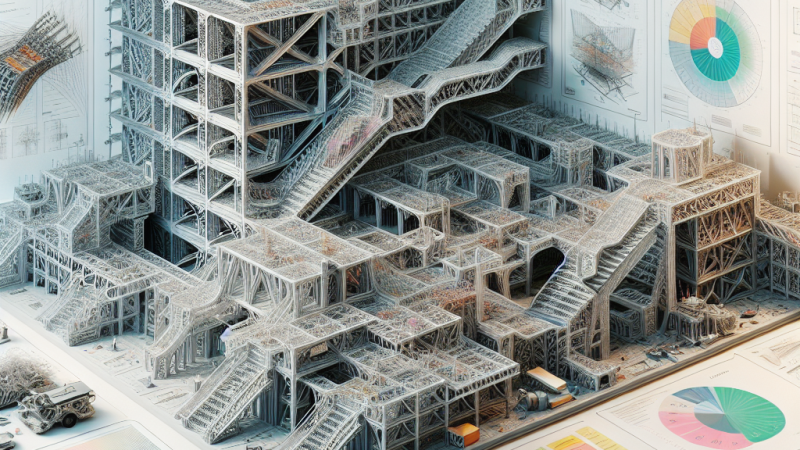
Structural analysis is a fundamental aspect of civil and structural engineering, focusing on the determination of the effects of loads on physical structures and their components. This field is crucial for ensuring the safety, stability, and functionality of buildings, bridges, towers, and other structures. The importance of structural analysis cannot be overstated, as it directly impacts the design, construction, and maintenance of infrastructure that supports modern society. This article delves into the historical development of structural analysis, exploring its basic principles, key milestones, practical applications, advanced topics, and the challenges faced in this ever-evolving field.
Fundamentals
Structural analysis involves the application of physical laws and mathematical techniques to predict the behavior of structures under various loads. The primary goal is to ensure that structures can withstand the forces and stresses they encounter during their lifespan. Key concepts in structural analysis include:
Definitions and Key Terms
- Load: Any external force or displacement applied to a structure.
- Stress: The internal force per unit area within a material.
- Strain: The deformation or displacement of material relative to its original length.
- Elasticity: The property of a material to return to its original shape after the removal of a load.
- Plasticity: The property of a material to undergo permanent deformation under load.
- Equilibrium: A state where the sum of forces and moments acting on a structure is zero.
Theories
Several theories form the foundation of structural analysis:
- Elastic Theory: Assumes that materials return to their original shape after the removal of loads, following Hooke’s Law.
- Plastic Theory: Considers the permanent deformation of materials under loads, essential for understanding failure mechanisms.
- Finite Element Method (FEM): A numerical technique for solving complex structural problems by dividing structures into smaller, manageable elements.
Historical Development
The evolution of structural analysis is marked by significant milestones and contributions from notable figures:
Ancient Civilizations
Early structural analysis can be traced back to ancient civilizations such as the Egyptians, Greeks, and Romans. The construction of monumental structures like the Pyramids, Parthenon, and Roman aqueducts demonstrated an empirical understanding of load distribution and material strength.
17th and 18th Centuries
The scientific revolution brought about a more systematic approach to structural analysis. Galileo Galilei’s work on the strength of materials and Robert Hooke’s formulation of Hooke’s Law laid the groundwork for modern structural analysis. In the 18th century, Leonhard Euler introduced the concept of buckling in columns, a critical aspect of stability analysis.
19th Century
The industrial revolution spurred advancements in structural analysis, driven by the need for larger and more complex structures. Notable contributions include:
- Thomas Telford: Pioneered the use of iron in bridge construction, exemplified by the Menai Suspension Bridge.
- Gustave Eiffel: Applied principles of structural analysis in the design of the Eiffel Tower, a marvel of engineering.
- Augustin-Louis Cauchy: Developed the theory of stress and strain, providing a mathematical framework for structural analysis.
20th Century
The 20th century saw the formalization of structural analysis as a discipline, with significant advancements in both theory and practice:
- Hardy Cross: Introduced the moment distribution method, a powerful technique for analyzing indeterminate structures.
- John von Neumann: Contributed to the development of the finite element method (FEM), revolutionizing structural analysis.
- Computational Advances: The advent of computers enabled the application of complex numerical methods, transforming structural analysis into a more precise and efficient process.
Applications
Structural analysis has a wide range of practical applications across various industries:
Civil Engineering
In civil engineering, structural analysis is essential for designing and constructing buildings, bridges, dams, and other infrastructure. For example, the analysis of skyscrapers involves understanding the effects of wind and seismic loads to ensure stability and safety.
Aerospace Engineering
Structural analysis is critical in aerospace engineering for designing aircraft and spacecraft. Engineers must analyze the stresses and strains on components to ensure they can withstand the extreme conditions of flight and space travel.
Mechanical Engineering
In mechanical engineering, structural analysis is used to design machinery, vehicles, and other mechanical systems. For instance, the analysis of automotive frames ensures they can absorb impact forces during collisions.
Case Studies
Several notable case studies highlight the importance of structural analysis:
- Millau Viaduct: The world’s tallest bridge, designed using advanced structural analysis techniques to withstand wind and seismic forces.
- Burj Khalifa: The tallest building in the world, requiring detailed analysis of wind loads and material strength to achieve its height.
Advanced Topics
Recent advancements in structural analysis have introduced new concepts and techniques:
Nonlinear Analysis
Nonlinear analysis considers the nonlinear behavior of materials and structures under large deformations and complex loading conditions. This approach provides more accurate predictions of structural performance and failure.
Dynamic Analysis
Dynamic analysis examines the response of structures to time-varying loads, such as earthquakes, wind, and vibrations. Techniques like modal analysis and time-history analysis are used to assess dynamic behavior.
Recent Innovations
Recent research has focused on integrating structural analysis with emerging technologies:
- Artificial Intelligence (AI): AI algorithms are being developed to optimize structural designs and predict failure mechanisms.
- Building Information Modeling (BIM): BIM integrates structural analysis with digital models, enhancing collaboration and accuracy in construction projects.
Challenges and Considerations
Despite its advancements, structural analysis faces several challenges:
Complexity
The increasing complexity of modern structures requires more sophisticated analysis techniques, which can be computationally intensive and time-consuming.
Material Behavior
Accurately modeling the behavior of new and advanced materials, such as composites and smart materials, presents a significant challenge in structural analysis.
Environmental Factors
Environmental factors, such as climate change and natural disasters, introduce uncertainties that must be accounted for in structural analysis.
Potential Solutions
Addressing these challenges requires ongoing research and innovation:
- Advanced Computational Methods: Developing more efficient algorithms and leveraging high-performance computing can reduce the computational burden of complex analyses.
- Material Testing and Modeling: Improved testing methods and material models can enhance the accuracy of structural analysis.
- Resilience and Adaptation: Designing structures with resilience and adaptability to changing environmental conditions can mitigate risks.
Conclusion
The historical development of structural analysis has been marked by significant milestones and contributions from numerous pioneers. From ancient empirical methods to modern computational techniques, structural analysis has evolved to meet the demands of increasingly complex structures. Its applications span various industries, ensuring the safety and functionality of critical infrastructure. As technology advances, structural analysis will continue to evolve, addressing new challenges and pushing the boundaries of engineering. The importance of structural analysis in engineering cannot be overstated, as it remains a cornerstone of safe and efficient design and construction.