Fluid Kinematics: Streamline, Pathline, Streakline
Introduction
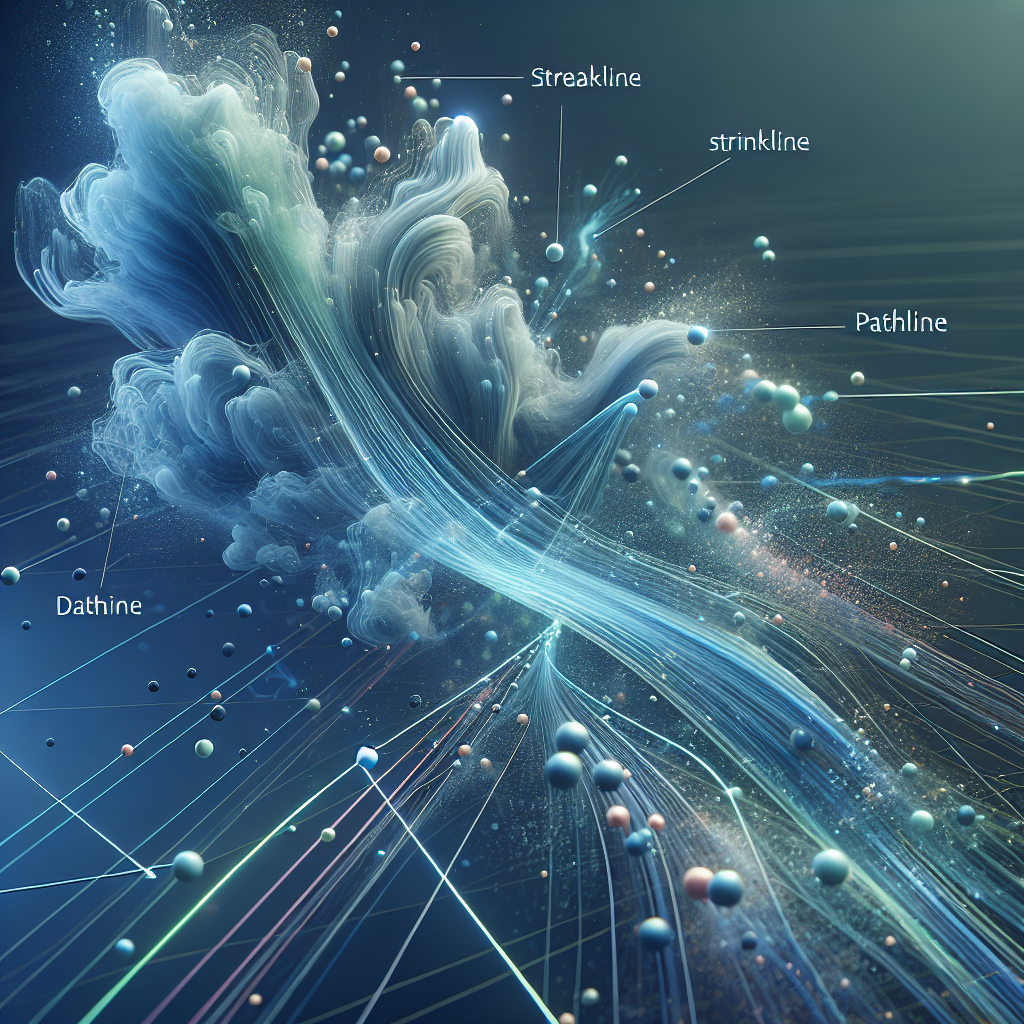
Fluid kinematics is a fundamental aspect of fluid dynamics, a branch of engineering that deals with the behavior of fluids (liquids and gases) in motion. Understanding fluid kinematics is crucial for engineers as it provides insights into the flow patterns, velocity fields, and the overall behavior of fluids in various applications. Among the key concepts in fluid kinematics are streamlines, pathlines, and streaklines. These concepts are essential for visualizing and analyzing fluid flow, which is vital in designing and optimizing engineering systems such as pipelines, aircraft, and hydraulic machines. This article delves into the importance, principles, historical development, applications, advanced topics, challenges, and considerations related to fluid kinematics, with a focus on streamlines, pathlines, and streaklines.
Fundamentals
Basic Principles and Concepts
Fluid kinematics involves the study of fluid motion without considering the forces and moments that cause the motion. The primary focus is on the velocity and acceleration of fluid particles. Key terms and concepts in fluid kinematics include:
- Velocity Field: A vector field that represents the velocity of fluid particles at different points in space and time.
- Streamline: A line that is tangent to the velocity vector of the fluid at every point. Streamlines represent the direction of fluid flow at a given instant.
- Pathline: The actual path traced by a single fluid particle over a period of time.
- Streakline: The locus of fluid particles that have passed through a specific point in space at different times.
Theories and Key Terms
Several theories and equations are fundamental to fluid kinematics:
- Continuity Equation: This equation expresses the principle of mass conservation in fluid flow. For an incompressible fluid, it is given by ∇·V = 0, where V is the velocity vector.
- Eulerian and Lagrangian Descriptions: The Eulerian description focuses on specific locations in the flow field, while the Lagrangian description follows individual fluid particles.
- Reynolds Number: A dimensionless number that characterizes the flow regime (laminar or turbulent) based on the ratio of inertial forces to viscous forces.
Historical Development
The study of fluid kinematics has a rich history, with contributions from several notable figures:
- Leonardo da Vinci (1452-1519): One of the earliest to study fluid flow, da Vinci made detailed observations and sketches of water flow patterns.
- Isaac Newton (1643-1727): Newton’s laws of motion laid the groundwork for understanding fluid dynamics.
- Leonhard Euler (1707-1783): Euler formulated the Euler equations, which describe the motion of an inviscid fluid.
- Claude-Louis Navier (1785-1836) and George Gabriel Stokes (1819-1903): Their work led to the Navier-Stokes equations, which describe the motion of viscous fluids.
These milestones have paved the way for modern fluid dynamics, enabling engineers to analyze and predict fluid behavior with greater accuracy.
Applications
Fluid kinematics has a wide range of practical applications across various industries:
Aerospace Engineering
In aerospace engineering, understanding fluid flow around aircraft is crucial for optimizing aerodynamic performance. Streamlines are used to visualize airflow over wings and fuselage, helping engineers design more efficient and stable aircraft.
Civil Engineering
In civil engineering, fluid kinematics is essential for designing water supply systems, sewage networks, and flood control measures. Pathlines and streaklines help in analyzing the movement of pollutants in water bodies, ensuring safe and sustainable water management.
Mechanical Engineering
Mechanical engineers use fluid kinematics to design and optimize hydraulic machines, pumps, and turbines. By analyzing the flow patterns within these machines, engineers can enhance their efficiency and performance.
Environmental Engineering
Environmental engineers study fluid kinematics to understand the dispersion of pollutants in the atmosphere and water bodies. This knowledge is vital for developing strategies to mitigate environmental pollution and protect ecosystems.
Advanced Topics
Computational Fluid Dynamics (CFD)
CFD is a powerful tool that uses numerical methods and algorithms to solve and analyze fluid flow problems. Advanced CFD techniques allow engineers to simulate complex flow scenarios, providing detailed insights into velocity fields, pressure distributions, and turbulence characteristics.
Particle Image Velocimetry (PIV)
PIV is an experimental technique used to visualize and measure fluid flow. It involves seeding the fluid with tracer particles and using laser imaging to capture their motion. PIV provides high-resolution data on velocity fields, enabling precise analysis of fluid behavior.
Recent Research and Innovations
Recent research in fluid kinematics focuses on developing more accurate and efficient computational models, improving experimental techniques, and exploring new applications. Innovations such as machine learning and artificial intelligence are being integrated with CFD to enhance predictive capabilities and optimize engineering designs.
Challenges and Considerations
Despite significant advancements, fluid kinematics presents several challenges:
- Complexity of Turbulent Flows: Turbulent flows are highly chaotic and difficult to predict. Developing accurate models for turbulence remains a major challenge in fluid dynamics.
- Computational Limitations: High-fidelity CFD simulations require significant computational resources. Balancing accuracy and computational efficiency is a key consideration.
- Experimental Limitations: Experimental techniques like PIV can be limited by factors such as particle seeding, laser intensity, and measurement resolution.
Addressing these challenges requires ongoing research and innovation. Potential solutions include developing more efficient algorithms, leveraging high-performance computing, and improving experimental methodologies.
Conclusion
Fluid kinematics, encompassing concepts such as streamlines, pathlines, and streaklines, is a vital area of study in fluid dynamics. It provides essential insights into fluid behavior, enabling engineers to design and optimize a wide range of systems across various industries. The historical development of fluid kinematics has been marked by significant contributions from notable figures, leading to the advanced techniques and tools available today. While challenges remain, ongoing research and innovation continue to push the boundaries of our understanding, ensuring that fluid kinematics remains a cornerstone of engineering practice. By mastering these concepts, engineers can develop more efficient, sustainable, and innovative solutions to meet the demands of the modern world.