Understanding Common Terms in Mechanical Engineering
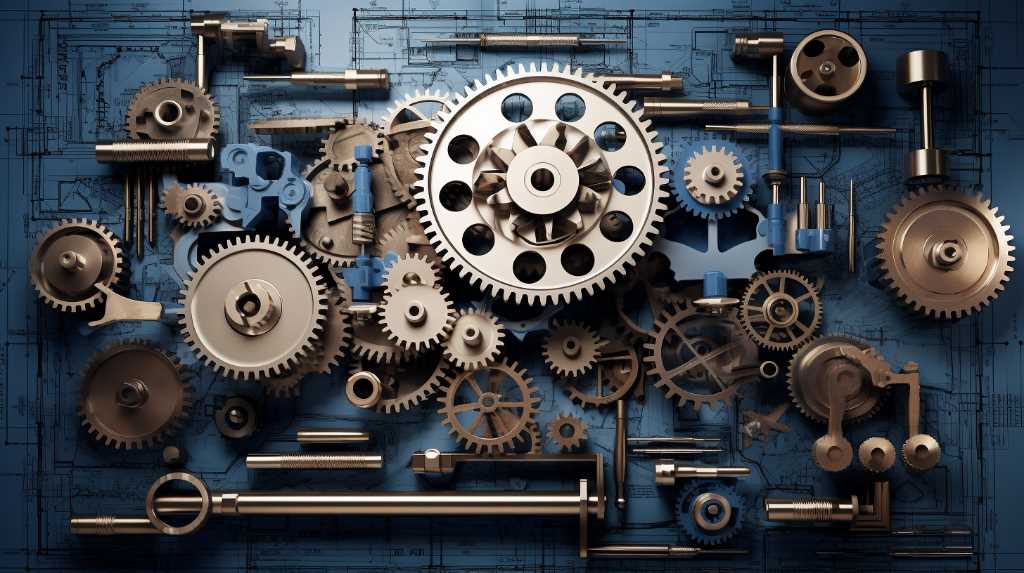
Mechanical engineering is a key field that involves designing, analyzing, making, and keeping mechanical systems running. To talk about concepts and processes clearly, people in this field need to know certain important words and ideas.
Understanding the basics of how things move and the forces on them is crucial. Learning about thermodynamics means studying energy and heat and how they change.
When we talk about fluid mechanics, we’re looking at how liquids and gases act. Knowing about the strength of materials and what they can handle helps us understand what different materials can and can’t do when they’re pulled or squished.
It’s also important to know about dynamics and designing machines because this helps us figure out how machines move and what forces are at work.
Knowing these terms helps people in mechanical engineering talk accurately and apply what they know in lots of different jobs.
Basic Mechanics Principles
In mechanical engineering, understanding forces, energy, and movement is crucial. A force makes objects move when nothing stops it. Energy is like money for machines—it lets them work. And movement is just how something changes place over time. These ideas are explained by rules like Newton’s laws, which tell us how things move, and the idea that energy is always conserved. There are also formulas for movement, which help engineers predict how machines will behave.
Knowing all this helps engineers make machines that use forces and energy well, leading to precise and useful movements. For example, when designing a roller coaster, engineers use these principles to make sure it’s both fun and safe. They calculate the forces at work to create thrilling loops and turns, while also ensuring the ride won’t be too rough for passengers. This shows how the basic principles of mechanics are applied to create real-world solutions.
Thermodynamics Essentials
Thermodynamics is really important for mechanical engineering. It’s the study of energy and heat and how they change, which is key when engineers are making and improving things like engines, fridges, power stations, and heating and cooling systems. Knowing about thermodynamics helps them figure out how these things will work and how to make them use energy better.
For instance, if engineers are working on a car engine, they need to understand thermodynamics to make sure the engine runs smoothly, doesn’t waste fuel, and doesn’t overheat. This is because thermodynamics tells us about the rules that energy follows, like how it can’t just disappear (that’s energy conservation) and how it tends to spread out (that’s entropy).
When mechanical engineers understand these energy rules, they can come up with new ideas and make machines and technology better for everyone. In a nutshell, without thermodynamics, we wouldn’t have a lot of the modern conveniences we rely on every day.
Core Concepts in Fluid Mechanics
After we learn about thermodynamics, we dive into fluid mechanics, which is also key in mechanical engineering.
This area looks at how liquids and gases behave when they move and when they’re still. It’s built on big ideas like continuity, which means you have to keep the amount of mass the same in a system, and Bernoulli’s equation, which connects pressure, how fast the fluid moves, and how high it is. Then there are these tough math formulas called the Navier-Stokes equations that explain how thick, sticky fluids move around. Also, we talk about whether fluid flows smoothly, which we call laminar flow, or chaotically, known as turbulent flow. This matters a lot when designing stuff to make sure the fluids go where we want them to.
It’s just as crucial to get how fluids act when they’re not moving, which is called fluid statics. This helps us figure out how pressure changes in fluids that aren’t moving, and it’s something engineers need to know for all sorts of projects.
For example, when engineers design a water pipeline system, they use Bernoulli’s equation to make sure the water pressure is strong enough to reach all the homes in a neighborhood. They also use fluid statics principles to prevent pipes from bursting due to high pressure when the water isn’t flowing.
Material Strength and Properties
In the field of mechanical engineering, it’s really important to know all about the strength and features of materials. This knowledge helps engineers pick the right stuff for their designs. Materials have different properties that tell us how they’ll act under certain conditions. Tensile strength is how well a material can hold up without snapping when it’s stretched. Yield strength is the point where a material starts to change shape permanently under pressure. These two are super important for keeping structures from falling apart.
Then there’s hardness, which is all about how tough a material is against dents and scratches. Toughness is a material’s knack for soaking up energy without breaking. Materials that can bend a bit without breaking have ductility, and if they can bounce back to their original shape after being bent, that’s called elasticity. Engineers need to test materials carefully to figure out these properties. By doing so, they can guess how a material will perform in real life and avoid choosing something that might fail.
For example, if you’re designing a bridge, you’d want materials with high tensile and yield strength for the cables, like a specific type of steel known for its durability. You’d also check the hardness and toughness to ensure the materials can handle the constant stress and wear over time.
It’s like picking the right ingredients for a recipe to make sure your dish turns out perfect and doesn’t fall flat.
Dynamics and Machine Design
Understanding how materials behave is just the start. Knowing about dynamics is super important when creating machines because it helps predict how things will move and how forces will act in those machines. Dynamics is all about figuring out how forces and spins, called torques, can cause movement or change it, and what happens in the machine as a result. It covers two big ideas: kinematics, which is all about movement without worrying about what causes it, and kinetics, which connects the movement to the forces behind it.
When engineers make machines, they use dynamics to make sure every part can handle the stress of working and do its job well, no matter the situation. They have to do some serious math to figure out how much force and motion, like shaking or resistance, each part will face to ensure that the machine will work smoothly and last a long time.
For example, when designing a roller coaster, engineers must calculate how fast it will go, how much the structure will shake, and how to make it safe and fun for riders. They need to know exactly how the coaster will react to the twists, turns, and drops they design. That’s where dynamics comes in — it’s like the rulebook for moving things in the world of machine design.
Conclusion
To truly understand mechanical engineering, you need to know the basics like mechanics, how heat and energy work (thermodynamics), the behavior of liquids and gases (fluid mechanics), what materials are made of, and how things move and interact (dynamics).
These are the building blocks that let you analyze, create, and improve everything from small parts to big systems in a lot of different fields. Being good at these areas is key to coming up with new ideas and making progress in the wide-reaching world of mechanical engineering.