Historical Development of Material Science
Introduction
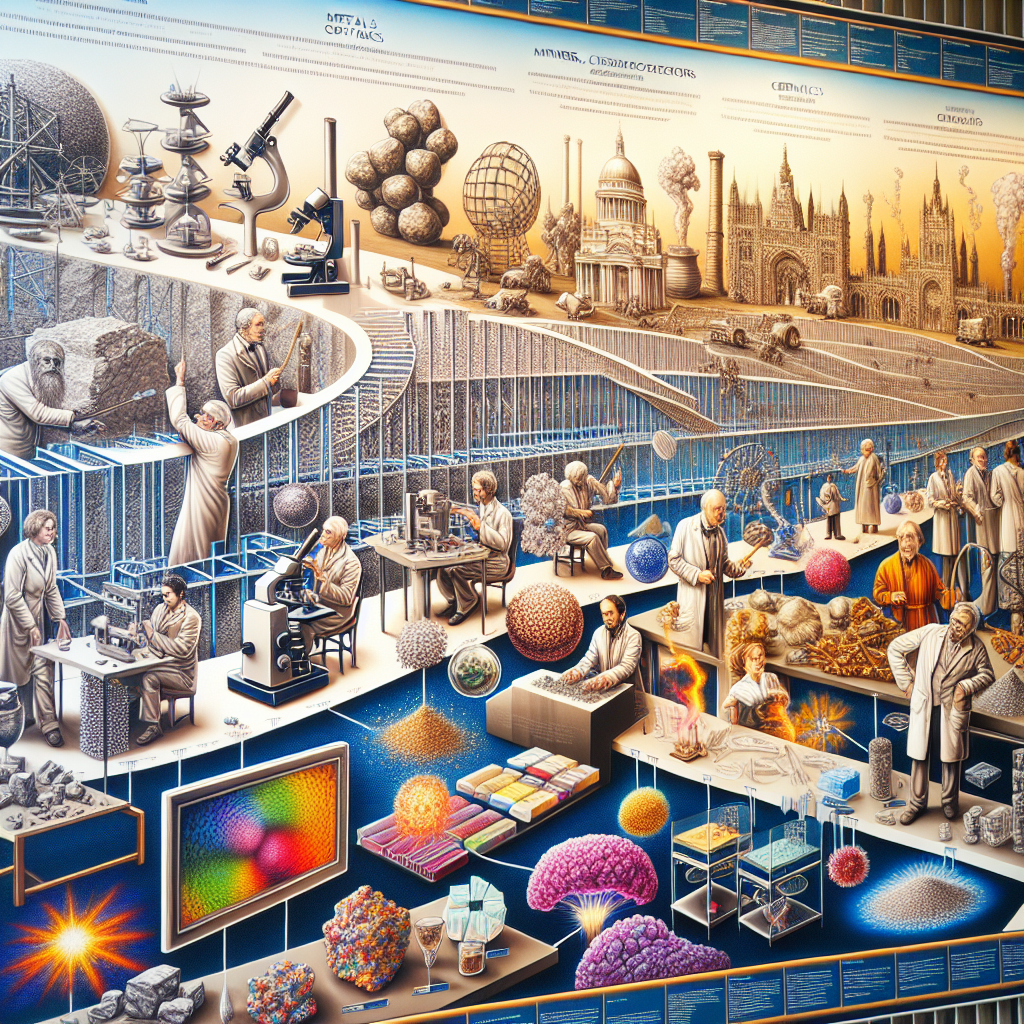
Material Science is a pivotal field in engineering that focuses on the discovery and design of new materials. It integrates principles from physics, chemistry, and engineering to understand the properties and behaviors of materials. The importance of Material Science in engineering cannot be overstated, as it underpins the development of new technologies and the improvement of existing ones. From the creation of stronger, lighter materials for aerospace applications to the development of biocompatible materials for medical implants, Material Science plays a crucial role in advancing modern engineering.
Fundamentals
Material Science is built on several fundamental principles and concepts. At its core, it involves the study of the structure, properties, processing, and performance of materials. These four interrelated components are often referred to as the “materials science tetrahedron.”
Structure
The structure of a material refers to the arrangement of its internal components, ranging from atomic to macroscopic scales. This includes the crystal structure of metals, the molecular structure of polymers, and the composite structure of materials like concrete.
Properties
Properties are the characteristics of a material that determine its behavior under various conditions. These can be mechanical (e.g., strength, ductility), thermal (e.g., conductivity, expansion), electrical (e.g., resistivity, dielectric constant), and more.
Processing
Processing involves the methods used to shape and treat materials to achieve desired properties. This includes techniques like casting, forging, welding, and additive manufacturing.
Performance
Performance refers to how a material behaves in its intended application. This includes its durability, reliability, and overall effectiveness in fulfilling its role.
Historical Development
The history of Material Science is rich and varied, with significant milestones that have shaped the field over centuries.
Ancient Times
Early humans used natural materials like stone, wood, and bone to create tools and structures. The discovery of metals like copper and bronze marked the beginning of the Bronze Age, around 3300 BCE, which revolutionized tool-making and construction.
Iron Age
The Iron Age, beginning around 1200 BCE, saw the widespread use of iron and steel. The development of smelting techniques allowed for the production of stronger and more durable tools and weapons.
Industrial Revolution
The Industrial Revolution in the 18th and 19th centuries brought about significant advancements in Material Science. The invention of the Bessemer process in 1856 allowed for the mass production of steel, which became a cornerstone of industrial development.
20th Century
The 20th century saw rapid advancements in Material Science, driven by the needs of World War II and the subsequent technological boom. The development of synthetic polymers, semiconductors, and composite materials revolutionized industries ranging from electronics to aerospace.
Notable Figures
- Henry Bessemer: Invented the Bessemer process for steel production.
- Wallace Carothers: Developed nylon, one of the first synthetic polymers.
- William Shockley: Co-inventor of the transistor, which revolutionized electronics.
Applications
Material Science has a wide range of applications across various industries.
Aerospace
In aerospace engineering, materials like titanium alloys and carbon-fiber composites are used to create lightweight, strong, and heat-resistant components for aircraft and spacecraft.
Biomedical
Biomedical engineering relies on biocompatible materials for implants, prosthetics, and medical devices. Materials like titanium, stainless steel, and certain polymers are used for their compatibility with human tissue.
Electronics
The electronics industry depends on materials like silicon for semiconductors, as well as various metals and polymers for circuit boards and components.
Construction
In construction, materials like concrete, steel, and advanced composites are used to build durable and resilient structures. Innovations in material science have led to the development of self-healing concrete and other advanced building materials.
Advanced Topics
Recent research and innovations in Material Science continue to push the boundaries of what is possible.
Nanomaterials
Nanomaterials, which have structures on the nanometer scale, exhibit unique properties that differ from their bulk counterparts. These materials are being explored for applications in electronics, medicine, and energy storage.
Smart Materials
Smart materials can change their properties in response to external stimuli like temperature, pressure, or electric fields. Examples include shape-memory alloys and piezoelectric materials.
2D Materials
Two-dimensional materials like graphene have exceptional electrical, thermal, and mechanical properties. Research is ongoing to explore their potential in various applications, including flexible electronics and advanced sensors.
Challenges and Considerations
Despite the advancements, Material Science faces several challenges and considerations.
Environmental Impact
The production and disposal of materials can have significant environmental impacts. Research is focused on developing sustainable materials and recycling methods to mitigate these effects.
Cost
The development and production of advanced materials can be costly. Finding cost-effective methods for manufacturing and processing these materials is a key area of research.
Scalability
Scaling up the production of new materials from the laboratory to industrial levels can be challenging. Ensuring consistent quality and performance at larger scales is crucial.
Conclusion
The historical development of Material Science has been marked by significant milestones and contributions from notable figures. From ancient tool-making to modern nanotechnology, the field has continually evolved to meet the needs of society. The practical applications of Material Science are vast, impacting industries ranging from aerospace to biomedical engineering. As research continues to advance, new materials and techniques will undoubtedly emerge, further pushing the boundaries of what is possible. Despite the challenges, the future of Material Science in engineering looks promising, with the potential to drive innovation and improve the quality of life for people around the world.