Applications of Solid Mechanics in Product Design
Introduction
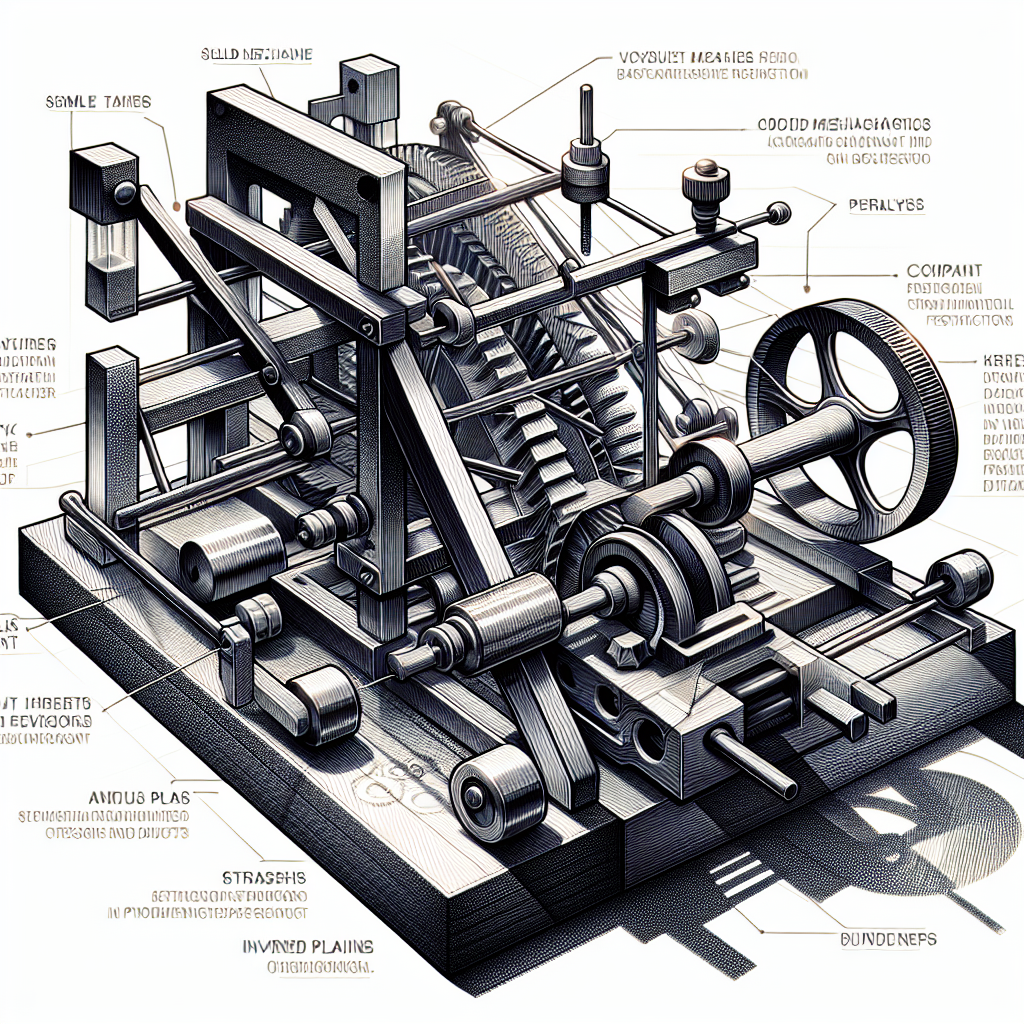
Solid mechanics, a fundamental branch of engineering mechanics, plays a crucial role in the design and analysis of products across various industries. It involves the study of the behavior of solid materials under various forces and conditions, providing essential insights into stress, strain, and deformation. The importance of solid mechanics in engineering cannot be overstated, as it ensures the structural integrity, safety, and functionality of products ranging from everyday consumer goods to complex aerospace components. This article delves into the applications of solid mechanics in product design, exploring its principles, historical development, practical applications, advanced topics, and associated challenges.
Fundamentals
Basic Principles and Concepts
Solid mechanics is grounded in several fundamental principles and concepts that are essential for understanding material behavior. Key terms and definitions include:
- Stress: The internal force per unit area within a material, typically measured in Pascals (Pa).
- Strain: The deformation or displacement of a material relative to its original length, expressed as a dimensionless ratio.
- Elasticity: The property of a material to return to its original shape after the removal of an applied force.
- Plasticity: The property of a material to undergo permanent deformation under applied stress.
- Fracture Mechanics: The study of the propagation of cracks in materials and the conditions under which they grow.
- Finite Element Analysis (FEA): A numerical method used to predict how a product reacts to real-world forces, vibration, heat, and other physical effects.
Theories such as Hooke’s Law, which describes the linear relationship between stress and strain in elastic materials, and the von Mises yield criterion, which predicts the onset of plastic deformation, are foundational to solid mechanics.
Historical Development
Key Milestones and Contributions
The field of solid mechanics has a rich history, with significant contributions from numerous scientists and engineers. Some key milestones include:
- 17th Century: Robert Hooke formulated Hooke’s Law, establishing the relationship between stress and strain in elastic materials.
- 18th Century: Leonhard Euler and Daniel Bernoulli developed the Euler-Bernoulli beam theory, which describes the behavior of beams under various loading conditions.
- 19th Century: Augustin-Louis Cauchy introduced the concept of stress tensors, providing a mathematical framework for analyzing stress in three dimensions.
- 20th Century: The development of computational methods, such as Finite Element Analysis (FEA), revolutionized the field by enabling complex simulations and analyses.
Notable figures such as Stephen Timoshenko, known as the father of modern solid mechanics, made significant contributions to the understanding of material behavior and structural analysis.
Applications
Practical Applications in Various Industries
Solid mechanics is integral to product design across a wide range of industries. Some notable applications include:
- Aerospace: In the aerospace industry, solid mechanics is used to design and analyze aircraft structures, ensuring they can withstand aerodynamic forces, pressure differentials, and thermal stresses. For example, the design of aircraft wings involves extensive FEA to optimize weight and strength.
- Automotive: In automotive engineering, solid mechanics is applied to design safer and more efficient vehicles. Crash simulations, for instance, use FEA to predict how a car’s structure will deform in a collision, leading to improved safety features.
- Construction: In civil engineering, solid mechanics principles are used to design buildings, bridges, and other structures. The analysis of load-bearing elements ensures that structures can support expected loads without failure.
- Consumer Electronics: In the design of consumer electronics, solid mechanics helps in creating durable and reliable products. For example, the design of smartphone casings involves stress analysis to prevent damage from drops and impacts.
- Medical Devices: In biomedical engineering, solid mechanics is used to design implants and prosthetics that mimic the mechanical properties of natural tissues. This ensures compatibility and longevity of medical devices.
Case Studies
One notable case study is the design of the Boeing 787 Dreamliner. Engineers used advanced FEA to analyze the composite materials used in the aircraft’s structure, optimizing for weight reduction while maintaining strength and durability. This led to significant improvements in fuel efficiency and performance.
Advanced Topics
Recent Research and Innovations
The field of solid mechanics continues to evolve with ongoing research and innovations. Some advanced topics include:
- Multiscale Modeling: This approach integrates material behavior at different scales, from atomic to macroscopic levels, providing a comprehensive understanding of material properties.
- Smart Materials: Research into materials that can change properties in response to external stimuli, such as shape-memory alloys and piezoelectric materials, is expanding the possibilities for innovative product designs.
- Topology Optimization: This technique uses computational algorithms to optimize material distribution within a given design space, leading to lightweight and efficient structures.
- 3D Printing: Advances in additive manufacturing are enabling the creation of complex geometries and customized products, with solid mechanics playing a crucial role in ensuring their structural integrity.
Future trends in solid mechanics research include the development of more accurate predictive models, the integration of artificial intelligence in design processes, and the exploration of new materials with unique mechanical properties.
Challenges and Considerations
Challenges and Limitations
Despite its advancements, the field of solid mechanics faces several challenges and limitations:
- Complexity of Materials: Accurately modeling the behavior of complex materials, such as composites and biological tissues, remains a significant challenge.
- Computational Resources: High-fidelity simulations, especially those involving large-scale structures or detailed microstructural analysis, require substantial computational power and resources.
- Uncertainty and Variability: Material properties can vary due to manufacturing processes, environmental conditions, and other factors, introducing uncertainty into analyses and designs.
- Interdisciplinary Integration: Integrating solid mechanics with other disciplines, such as fluid dynamics and thermodynamics, to create comprehensive models can be complex and challenging.
Potential Solutions and Areas for Further Research
Addressing these challenges requires ongoing research and innovation. Potential solutions include:
- Advanced Material Characterization: Developing more accurate methods for characterizing material properties at different scales can improve the reliability of models and simulations.
- High-Performance Computing: Leveraging advancements in computing technology can enhance the capability to perform complex simulations and analyses.
- Uncertainty Quantification: Incorporating probabilistic methods and uncertainty quantification techniques can help account for variability and improve the robustness of designs.
- Interdisciplinary Collaboration: Fostering collaboration between different engineering disciplines can lead to more integrated and comprehensive solutions.
Conclusion
Solid mechanics is a cornerstone of engineering, providing essential insights into the behavior of materials and structures under various conditions. Its applications in product design span numerous industries, from aerospace and automotive to consumer electronics and medical devices. The field has a rich history, with significant contributions from notable figures and ongoing advancements in research and technology. While challenges remain, continued innovation and interdisciplinary collaboration hold the promise of overcoming these obstacles and driving further progress. The importance of solid mechanics in engineering cannot be overstated, as it ensures the safety, reliability, and performance of products that shape our world.