Finite Element Method (FEM)
Introduction

The Finite Element Method (FEM) is a powerful computational technique used extensively in the field of structural analysis in engineering. It allows engineers to create detailed simulations of complex structures and systems, enabling them to predict how these structures will behave under various conditions. FEM is crucial for designing safe and efficient buildings, bridges, aircraft, and many other structures. Its importance lies in its ability to provide accurate and reliable results, which are essential for ensuring the safety and performance of engineering projects.
Fundamentals
Basic Principles and Concepts
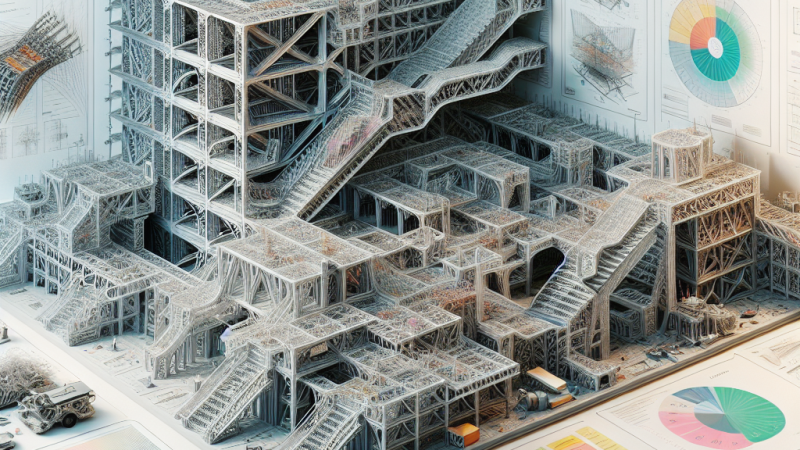
At its core, the Finite Element Method involves breaking down a complex structure into smaller, simpler parts called finite elements. These elements are connected at points known as nodes. By solving the equations that govern the behavior of each element, engineers can predict the behavior of the entire structure.
Key Terms
- Element: A small, simple part of a larger structure, typically represented by a mathematical model.
- Node: A point where elements are connected, serving as a reference for the element’s position and behavior.
- Mesh: A network of elements and nodes that represents the entire structure.
- Stiffness Matrix: A matrix that represents the stiffness of each element in the mesh.
- Boundary Conditions: Constraints applied to the nodes or elements to simulate real-world conditions.
Theories
The Finite Element Method is based on several mathematical theories, including:
- Variational Methods: These methods involve finding the function that minimizes or maximizes a certain quantity, such as energy.
- Galerkin Method: A method for converting a continuous problem into a discrete problem by approximating the solution with a finite number of basis functions.
- Matrix Algebra: The use of matrices to represent and solve systems of linear equations.
Historical Development
The development of the Finite Element Method can be traced back to the 1940s and 1950s. The method was initially developed for solving complex problems in structural mechanics and elasticity. Key milestones in the development of FEM include:
- 1943: Richard Courant introduced the concept of using piecewise polynomial functions to approximate solutions to partial differential equations.
- 1956: Ray W. Clough coined the term “Finite Element Method” and demonstrated its application to structural analysis.
- 1960s: The method gained popularity in the aerospace industry, with significant contributions from engineers such as John Argyris and Olgierd Zienkiewicz.
- 1970s: The development of computer technology allowed for more complex and detailed simulations, further advancing the method.
Applications
The Finite Element Method has a wide range of applications across various industries and fields. Some notable examples include:
Structural Engineering
FEM is used to analyze and design buildings, bridges, dams, and other structures. Engineers can simulate the effects of loads, such as wind, earthquakes, and traffic, to ensure the safety and stability of these structures.
Aerospace Engineering
In the aerospace industry, FEM is used to design and analyze aircraft, spacecraft, and their components. Engineers can predict how these structures will behave under different flight conditions, such as turbulence and high-speed maneuvers.
Automotive Engineering
FEM is used to design and analyze vehicles and their components, such as engines, chassis, and suspension systems. Engineers can simulate crash tests and other scenarios to improve safety and performance.
Biomedical Engineering
FEM is used to analyze and design medical devices, such as prosthetics, implants, and surgical instruments. Engineers can simulate the interaction between these devices and the human body to ensure their effectiveness and safety.
Case Studies
One notable case study is the use of FEM in the design of the Burj Khalifa in Dubai, the world’s tallest building. Engineers used FEM to analyze the building’s structure and ensure its stability under various loads, including wind and seismic forces.
Advanced Topics
Nonlinear Analysis
Nonlinear analysis involves solving problems where the relationship between variables is not linear. This is important for accurately modeling complex behaviors, such as material plasticity and large deformations.
Dynamic Analysis
Dynamic analysis involves studying the behavior of structures under time-varying loads, such as earthquakes and vibrations. This is crucial for designing structures that can withstand dynamic forces.
Multiphysics Analysis
Multiphysics analysis involves solving problems that involve multiple physical phenomena, such as thermal, fluid, and structural interactions. This is important for accurately modeling complex systems, such as nuclear reactors and electronic devices.
Recent Research and Innovations
Recent research in FEM includes the development of more efficient algorithms, advanced material models, and improved methods for handling large-scale problems. Innovations such as machine learning and artificial intelligence are also being integrated into FEM to enhance its capabilities.
Challenges and Considerations
Computational Complexity
One of the main challenges of FEM is its computational complexity. Solving large-scale problems can require significant computational resources and time. Advances in computer technology and parallel computing are helping to address this challenge.
Accuracy and Validation
Ensuring the accuracy of FEM simulations is crucial. This involves validating the results against experimental data and other reliable sources. Engineers must also carefully select the appropriate mesh size and element type to balance accuracy and computational efficiency.
Material Modeling
Accurately modeling the behavior of materials is essential for reliable FEM simulations. This involves understanding the material properties and how they change under different conditions. Advanced material models are being developed to improve the accuracy of FEM simulations.
Future Research
Future research in FEM includes the development of more efficient algorithms, advanced material models, and improved methods for handling large-scale problems. Innovations such as machine learning and artificial intelligence are also being integrated into FEM to enhance its capabilities.
Conclusion
The Finite Element Method is a powerful and versatile tool in the field of structural analysis in engineering. Its ability to provide accurate and reliable results makes it essential for designing safe and efficient structures. While there are challenges and considerations associated with FEM, ongoing research and innovations are helping to address these issues. As technology continues to advance, the capabilities of FEM will continue to expand, making it an even more valuable tool for engineers in the future.